Why 1.6T Optical Modules Hit a Thermal Wall: 7 Facts (TEC, EML, CPO)
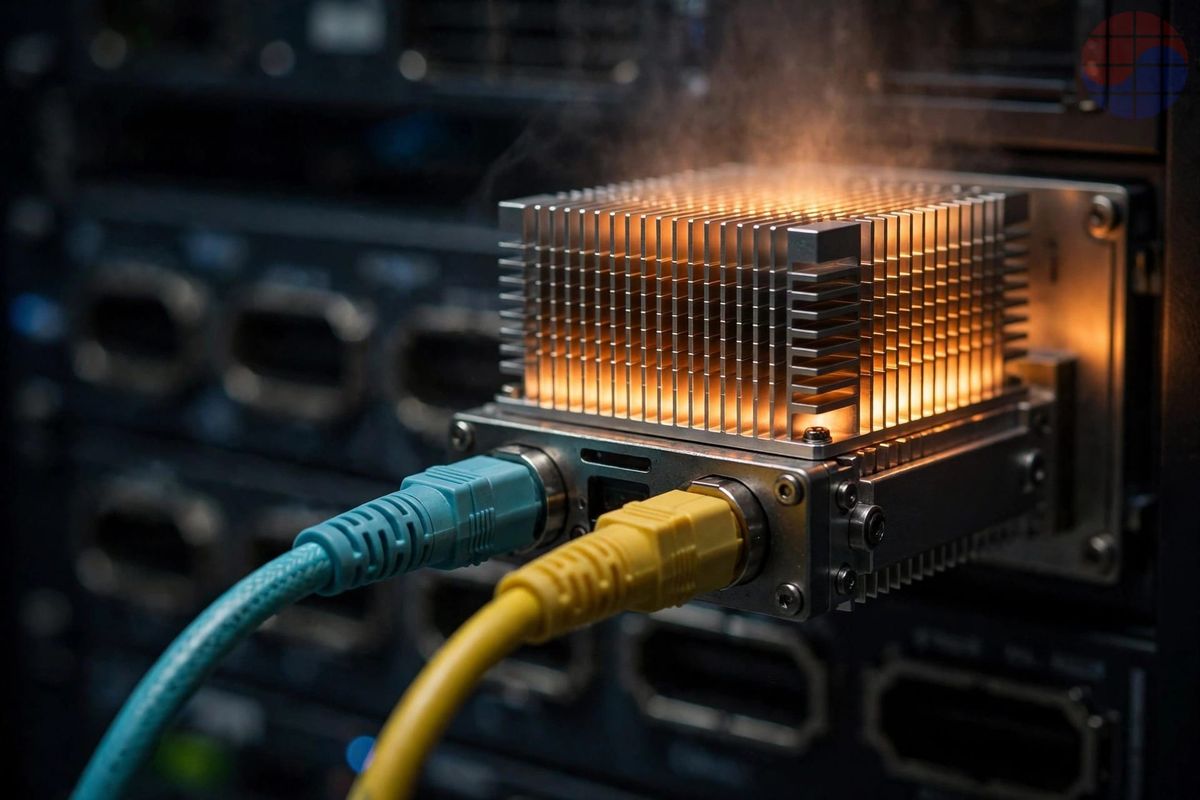
An 800G module draws 12.9W; a 1.6T module can draw nearly 30W in the same envelope. Seven facts on the laser that drifts with temperature, the thermoelectric cooler that holds it, and the architectures racing to need less cooling.
One-line verdict: The step from 800G to 1.6T optical modules is usually told as a bandwidth story. The datasheets tell a thermal story: a DSP-based 1.6T OSFP module can draw up to about 30W in the same plug envelope where an 800G module draws 12.9W typical and 16W maximum, and inside that envelope a laser whose wavelength drifts about 0.1 nm per degree Celsius has to be held at a fixed temperature by a thermoelectric cooler (TEC) that itself consumes power.
Whoever solves the heat — cooled EML, silicon photonics, linear-drive optics, or external lasers in co-packaged optics — decides the cost of every AI network port in 2027.
30-second summary
- Module power roughly doubles per port: 800G OSFP at 12.9W typical / 16W maximum (vendor datasheet, January 2026) versus 1.6T OSFP DR8 specified below 30W maximum, with silicon-photonics demo modules below 21W typical (OFC 2025 demo materials).
- Energy per bit still improves — about 20 pJ/bit at 800G with a DSP versus about 18.8 pJ/bit at 1.6T, and about 6.3 pJ/bit for a 10W linear-drive 1.6T module — but switches are cooled per port, not per bit: 64 ports at 30W is 1,920W of optics heat in one box (own calculations, November 2026).
- The laser is the temperature-sensitive part: a DFB/EML laser drifts roughly 0.1 nm per °C, so a few degrees can move a channel — the reason a Peltier thermoelectric cooler sits inside cooled modules (vendor application notes, 2024-2025).
- Every architecture on the 2027 roadmap is, in part, a thermal decision: DSP modules pay power for reach and signal quality, LPO/LRO remove the DSP, silicon photonics integrates the optics, and co-packaged optics moves the laser out of the hot zone — or brings micro-TECs back in at chip scale (thermal-management review, Advanced Photonics Nexus, 2026).
- Korea read: AI factories and HBM lines do not run without this layer. Korea buys optics at hyperscale for its AI data centers, and its packaging and materials suppliers sell into the same thermal stack — the module thermal wall is a Korean supply-chain question, not only a network-equipment one.
Background
Optical modules are the plumbing of AI clusters. Every GPU rack in a modern AI factory connects to its neighbours through hundreds of pluggable transceivers, and the industry is mid-transition from 800G modules to 1.6T modules as switch silicon moves to 200 Gb/s per lane.
The OSFP form factor — the plug these modules share — was designed for this progression, with the OSFP MSA specification (Rev 5.22, August 9, 2025) covering OSFP800 and OSFP1600 variants in the same mechanical envelope.
That fixed envelope is the problem. Bandwidth doubled; the box did not. A module is a small metal case, roughly the size of a pack of gum, containing a DSP, laser drivers, one or more lasers, photodetectors and — in cooled designs — a thermoelectric cooler holding the laser at a set temperature. All of its electrical power becomes heat inside that case, and the only way out is through the case walls and the riding heatsink on top, into the switch's airflow.
Coverage of the 1.6T transition tends to focus on who ships first and at what price. The thermal layer gets less attention because it sits inside other companies' products: the TEC is a component inside a laser subassembly inside a module inside a switch. Yet it is the layer where physics, not roadmaps, sets the limit — and where a small set of design choices (cooled versus uncooled lasers, DSP versus linear drive, pluggable versus co-packaged) reprices the whole network.
This analysis uses only primary and vendor sources — module datasheets, the OSFP MSA specification, OFC 2025 interoperability demo materials, and thermoelectric-cooling application notes and reviews — and adds its own calculations for per-bit energy and per-switch optics power. All figures are as stated by their sources as of November 28, 2026.
Deep Dive — 7 Facts
Fact 1. Per-port heat roughly doubles from 800G to 1.6T
Conclusion: the same OSFP envelope that hosts an 800G module at 12.9W typical and 16W maximum (vendor datasheet for 800G OSFP modules, January 2026) must now host 1.6T modules specified below 30W maximum for DSP-based DR8 designs, with a silicon-photonics 1.6T DR8 demo module below 21W typical and another below 30W in OFC 2025 interoperability materials (March 2025).
The spread inside 1.6T is as important as the step itself: architecture, not generation, decides whether a port costs 10W or 30W. A 1.6T LPO (linear pluggable optics) DR8 module is specified below 10W maximum and an LRO variant below 18W in vendor brochure data — because removing the DSP removes the single hottest chip in the module. The thermal wall is therefore not a fixed ceiling; it is a price list for design choices.
Fact 2. Energy per bit improves — and that does not cool the switch
Conclusion: dividing module power by line rate gives about 20 pJ/bit for a 16W 800G DSP module, about 18.8 pJ/bit for a 30W 1.6T DSP module, about 13.1 pJ/bit for a 21W silicon-photonics module and about 6.3 pJ/bit for a 10W LPO module (own calculations, November 2026). Efficiency marketing uses the per-bit number because it always improves. Cooling design cannot: a switch is built and cooled per port.
Multiply by port count and the numbers become physical — 64 ports at 30W draw 1,920W for optics alone, against 1,024W at 800G DSP power and 640W with 10W LPO modules (own calculations). In a rack where the switch sits above accelerators that already define the power budget, a 1.3 kW swing from module choice alone is a facility decision, not a component detail.
Fact 3. The laser drifts with temperature — about 0.1 nm per degree
Conclusion: a semiconductor laser's output wavelength is a function of its temperature. For the DFB and EML lasers used in data center optics, the coefficient is roughly 0.1 nm per °C, and output power and reliability also shift with temperature (thermoelectric-cooling application notes, 2024-2025). In a CWDM system with 20 nm channel spacing, a few degrees of drift is tolerable.
In denser wavelength plans it is not: eight degrees of drift equals a full 0.8 nm DWDM channel spacing. Temperature also ages lasers — running hot shortens life — so the laser's temperature is a controlled variable in any module that promises a wavelength and a lifetime. This single physical fact is why thermal control exists inside the module at all, and why it cannot simply be deleted to save power.
Fact 4. The TEC is a solid-state thermostat that pays for stability with power
Conclusion: the thermoelectric cooler is a Peltier device — a semiconductor sandwich that pumps heat from one face to the other when current flows, and can heat or cool depending on direction. Placed under the laser in a transmitter optical subassembly, it holds the laser at its set point against both ambient swings and the module's own heat.
Suppliers of micro-TECs for transceivers describe the same job across 400G, 800G and 1.6T: precise temperature stabilization in a shrinking form factor, with tens of millions of units shipped into optical communications (Phononic product materials, July 23, 2024; Tark Solutions application notes, March 23, 2025). The cost is structural: the TEC consumes electrical power to move heat, and its own consumption rises with the temperature difference it must hold.
In a hot 1.6T module, the thermostat is fighting a hotter room — stability gets more expensive exactly as modules get denser.
Fact 5. Uncooled and linear-drive designs are the counter-move
Conclusion: the industry's answer is not only better coolers; it is needing less cooling. Three routes recur in current vendor data. First, uncooled or wider-temperature laser designs that accept drift where the wavelength plan allows it, deleting the TEC and its power.
Second, linear-drive optics (LPO, and the half-retimed LRO): an 800G LPO module runs at roughly 8.5W typical in industry guides against over 16W for a DSP design, and a 1.6T LPO DR8 is specified below 10W — the DSP's heat was never optical at all. Third, silicon photonics, which integrates modulators on a photonic chip and showed 1.6T demo modules below 21W typical at OFC 2025.
Each route trades something away — reach, signal margin, or manufacturing maturity — which is why all of them coexist on 2027 roadmaps instead of one winning outright.
📩 Following this story?
Get the follow-up analysis — earnings, reports and HBM supply — in your inbox daily at 10:30 KST. Subscribe free →
Fact 6. Co-packaged optics moves the heat problem; it does not delete it
Conclusion: co-packaged optics (CPO) places the optical engine beside the switch ASIC and typically feeds it from an external laser source (ELS) — a deliberate thermal decision: the laser, the most temperature-sensitive component, leaves the hot package and lives where it can be cooled and serviced. A 2026 thermal-management review of CPO (Advanced Photonics Nexus, Vol.
5, 2026) notes that many CPO implementations adopt external lasers precisely to avoid complex in-package temperature control, while designs that integrate lasers on-chip — comb sources and WDM engines — bring the requirement back, with localized micro-TECs around each laser as the emerging answer.
The IEEE Heterogeneous Integration Roadmap's photonics chapter (2026 revision) describes the same concept: micro-TECs at specific chip locations for precision local control next to a switch ASIC generating over 500W. CPO therefore changes the TEC's scale and address — from module to chip neighbourhood — rather than ending it.
Fact 7. For Korea, the thermal wall is a purchasing bill and a supply-chain opening at once
Conclusion: Korea sits on both sides of this layer. As a buyer, its AI data center buildout — anchored by the same GPU clusters that drive global optics demand — will pay the per-port price of the 1.6T transition: at fleet scale, the difference between 30W and 10W modules is measured in megawatts of facility power and in how many racks a power-capped site can light.
As a supplier base, Korea's strength is adjacent rather than in the module itself: advanced packaging, substrates and materials are where Korean firms already sell into the optical and accelerator stack, and the micro-TEC direction of travel — smaller, integrated, materials-driven (bismuth-telluride thermoelectrics) — plays toward packaging and materials competence.
Practically: when a Korean AI factory negotiates optics, the module's wattage and cooling architecture deserve the same scrutiny as its price per gigabit, because the wattage is paid every hour the port is lit, for the life of the installation.
Chase's Take (VLSI + MBA lens)
The cleanest way to read the 1.6T transition is as a repricing of heat. Bandwidth is the headline; the datasheet variable that actually changed sign is watts per port inside a fixed metal envelope. Every architecture competing for 2027 — DSP pluggables, LPO/LRO, silicon photonics, CPO with external lasers — is a different answer to the same question: where does the heat go, and who pays to move it?
The TEC deserves attention precisely because it is unglamorous. It has no bandwidth roadmap and no keynote. But it embodies the trade at the centre of this layer: stability is bought with power, and the price rises with density.
The most interesting engineering of the next two years is the attempt to need less of it — uncooled lasers where the wavelength plan forgives drift, micro-TECs that cool only the laser instead of the module, external lasers that leave the hot zone entirely. Watch which of those three shows up in volume shipments; that, more than any demo, marks where the physics settled.
A practitioner's note: thermal limits fail differently from bandwidth limits. A link that is short of bandwidth degrades gracefully; a module that is short of cooling margin fails by wavelength drift, rising error rates and shortened laser life — field failures, months later, at fleet scale. That asymmetry is why conservative operators pay the TEC tax today even while funding every programme that promises to repeal it.
Implications
- For network buyers: compare 1.6T modules on watts per port and cooling architecture, not only price per gigabit — at 64 ports, module choice swings optics power between roughly 640W and 1,920W per switch (own calculations, November 2026).
- For module and laser suppliers: the TEC line item grows with density in cooled designs, while uncooled and micro-TEC designs attack it — both directions are business, for different supplier sets.
- For CPO programmes: the external-laser decision is a thermal and serviceability decision as much as an optical one; integrated-laser CPO re-imports precision cooling at chip scale (Advanced Photonics Nexus, 2026).
- For Korean AI infrastructure: optics wattage is facility capacity. In power-capped sites, lower-power module architectures convert directly into more lit racks.
- What to verify next: volume-shipment power figures for 1.6T DSP modules against their sub-30W specifications, the share of LPO/LRO in 2027 deployments, and whether micro-TEC integration appears in shipping CPO engines or stays in roadmap documents.
FAQ
Why does a 1.6T optical module need cooling for its laser?
Because a DFB/EML laser's wavelength drifts with temperature — roughly 0.1 nm per °C — and its output power and lifetime also depend on temperature. In wavelength-multiplexed systems a few degrees of drift can move a channel. Cooled modules therefore hold the laser at a fixed temperature with a thermoelectric cooler (TEC), per vendor application notes on transceiver cooling (2024-2025).
How much power does a 1.6T optical module use?
It depends on architecture. Vendor data accessed in November 2026 specifies a DSP-based 1.6T OSFP DR8 module below 30W maximum, silicon-photonics demo modules below 21W typical (OFC 2025), an LRO variant below 18W, and an LPO (linear-drive) DR8 module below 10W. For comparison, an 800G OSFP module is listed at 12.9W typical and 16W maximum in a January 2026 datasheet.
What is a TEC in an optical module?
A thermoelectric cooler: a solid-state Peltier device with no moving parts that pumps heat across its faces when current flows, heating or cooling as directed. In a transceiver it sits under the laser and acts as a precision thermostat. It consumes power itself, and its consumption rises with the temperature difference it must maintain.
Does co-packaged optics (CPO) remove the need for laser cooling?
Not entirely. Most current CPO designs use an external laser source, which moves the laser away from the hot switch package and eases its cooling. Designs that integrate lasers on the photonic chip still need precision temperature control, and recent thermal-management reviews describe localized micro-TECs integrated around each laser as the emerging solution (Advanced Photonics Nexus, 2026; IEEE Heterogeneous Integration Roadmap, 2026).
Sources
- Cisco 800G OSFP transceiver module datasheet, January 5, 2026 — 800G VR8 module power 12.9W typical, 16W maximum.
- OSFP MSA, OSFP Module Specification Rev 5.22, August 9, 2025 — OSFP800 and OSFP1600 form-factor definitions.
- OIF interoperability demo materials, OFC 2025, March 27, 2025 — 1.6T DR8 modules below 21W and below 30W typical power.
- Phononic, thermoelectric coolers for pluggable transceivers, July 23, 2024 — TEC role and deployments in optical communications.
- Tark Solutions (Laird Thermal Systems), optical transceiver cooling application notes, March 23, 2025 — laser temperature, wavelength stability and micro-TEC design for 400G to 1.6T.
- Thermal management in co-packaged optics, Advanced Photonics Nexus Vol. 5, 2026 — external laser sources, micro-TEC integration for on-chip lasers.
- IEEE Heterogeneous Integration Roadmap, Photonics chapter, 2026 revision — thermally integrated photonic systems and micro-TEC placement near high-power switch ASICs.
- Vendor brochure data for 1.6T OSFP modules (DR8 below 30W, LPO below 10W, LRO below 18W), accessed November 2026.
This article organizes publicly available datasheet, specification and review material as of November 28, 2026, and adds its own calculations, which are labeled as such. Vendor power figures are specifications or demo values as stated by their sources, not independent measurements. It is not investment advice and makes no recommendation on any security.
📩 Missed today's analysis? Get tomorrow's in your inbox
Daily Silicon at 10:30 KST plus earnings and analyst-report breakdowns, first. Samsung Electronics, SK hynix, TSMC and HBM supply, read by practicing engineers.
Subscribe free →
Free · No spam · Unsubscribe anytime
⚖️ Notice
This article is an industry and company analysis prepared from public sources — regulatory filings, company announcements and press reports — for information purposes only. It is not a recommendation to buy or sell any financial instrument and is not investment advice. Any target prices or investment opinions cited here are those of the institutions that issued them, not of VLSI Korea.
Forecasts and assessments are based on public information available at the time of writing, may differ from actual outcomes, and are not guaranteed to be accurate or complete. All investing involves a risk of loss of principal, and final investment decisions and their consequences rest solely with the investor.
This article was drafted with the assistance of AI tools and is reviewed and published by an editor. If you find a factual error, please let us know via our corrections page; verified errors are corrected with a visible correction note.
Editor's note (conflict-of-interest disclosure): The operator of VLSI Korea is a practicing engineer in the EDA industry. This article was prepared solely from public sources (regulatory filings, press releases, papers, and public data), and no non-public information of the operator's employer was used. This article is not a view of the employer; it is the analysis of a personally operated publication unrelated to the employer.