IMPHAL: The question of whether the Church played a major role in the Manipur violence—and allegedly leveraged armed Kuki militants to advance a larger geopolitical goal—has gained prominence since ethnic clashes broke out on May 3, 2023.
The morning after the violence erupted, on May 4, 2023, Organiser Weekly published a special report titled “Manipur: Backed by churches & militant groups, protest against ST demand of Meitei community turned violent,” which highlighted the endorsement of Church leaders in the so-called Tribal Solidarity March.
The underlying motive of the rally, held under the theme “Come now, let us reason together,” came under sharp scrutiny when the march turned violent and photos and videos surfaced showing several rallyists brandishing sophisticated weapons like AK-47s.
Also Read: PM Modi vows to implement Nari Shakti Vandan Amendment Bill; Slams Congress for prioritising politics over nation This raises a fundamental question: why did the Tribal Churches Leaders’ Forum, Manipur, endorse such a rally? Isn’t the Church meant to be a place of worship that fosters peace and harmony, rather than an institution pursuing political or territorial missions? A ‘Kuki Country’?
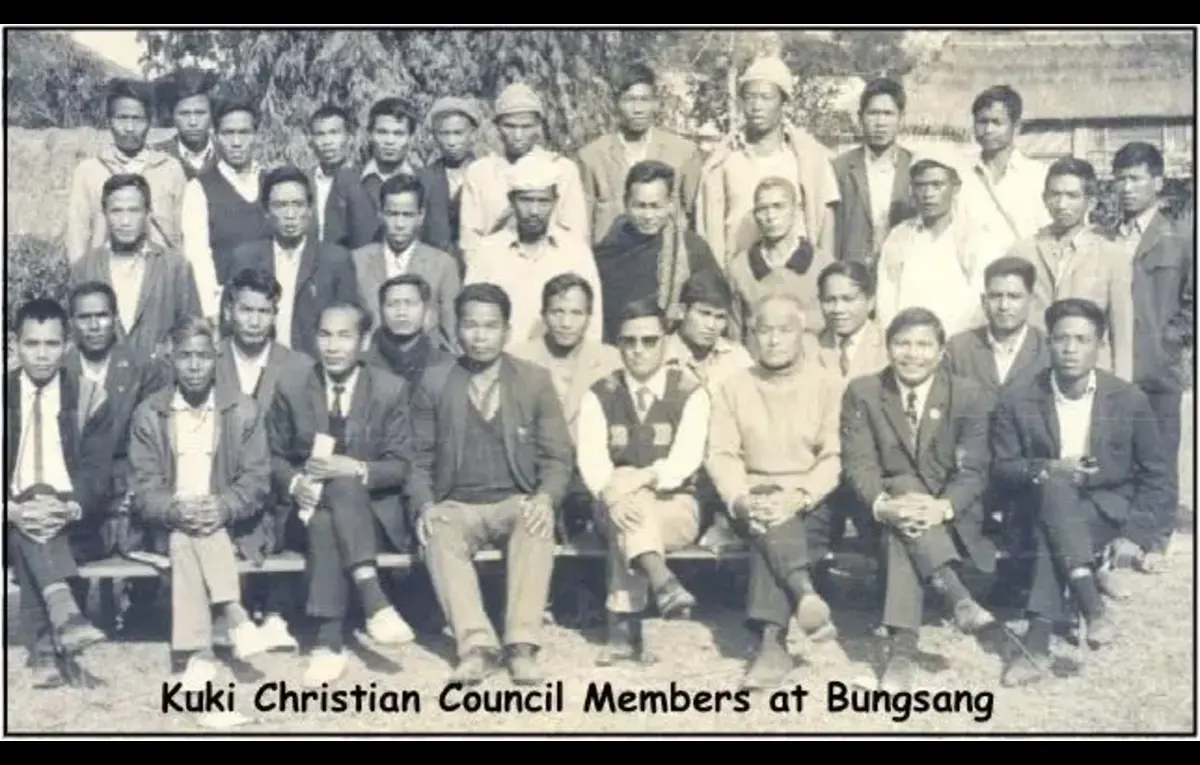
According to the Joshua Project—an evangelical Christian research and missions initiative that tracks ethnic and linguistic people groups worldwide—91.46 percent of Kuki-Chin tribes are Christian, leaving no community under the broader Kuki-Chin umbrella classified as “Unreached” by evangelists. One prominent evangelical body operating in this space is the Kuki Christian Council. In an April 19, 2016 report on the Kuki Christian Church website, Administrative Secretary T.
Lunkim stated that the “Kuki Christian Council was declared on April 8, 1979, at Chalwa Baptist Church, Sadar District, Manipur State, as Kuki Christian Church by representatives from different denominational churches amongst the Kuki Christians of the Kuki country—the country presently divided across a portion of northeastern India, northwestern Burma (Myanmar), and the remaining portion included in newly formed Bangladesh.” Also Read: Houthis Strikes on Saudi Arabia: Riyadh airport, oil facilities, power stations targeted amid soaring security crisis This statement openly points to the long-cherished aspiration among certain evangelical and ethno-nationalist networks to carve out a Christian sovereign state for the Chin-Kuki populace across India, Myanmar, and Bangladesh—much like the Democratic Republic of Timor-Leste, which emerged out of Indonesia in 2002 as a Christian-majority nation.
This is scarcely a hidden agenda. In subsequent coverage, Organiser Weekly has continued to highlight the role of Church networks during and after the violence under headlines such as Church-Sponsored Manipur Violence? and Manipur: Backed by churches & militant groups, protest against ST demand of Meitei community turned violent.
The Trajectory of Christian Nationalism To understand the ideological roots of this cross-border territorial ambition, one must look at the broader history of Christian nationalism in India’s Northeast—a blueprint first forged in the Naga Hills.
Also Read: Tripura: Bangladeshi national, 4 alleged Indian touts arrested near UNC Nagar border area The notion of Christian nationalism and a sovereign Christian state in the northeastern part of India was conceived following World War I, when 2,000 Nagas—mostly from the animist society of the then Naga Hills District of Assam Province in British India—were sent to France as part of the labour corps under the leadership of R.S. Ruichumhao.
After these 2,000 Nagas returned from France, the Naga Club was formed in 1918 in Kohima and Mokokchung. This was the first pan-Naga socio-political organization and later laid the groundwork for the Naga self-determination movement. As missionary education expanded and Christianity spread across the hills over the following decades, this movement gained critical momentum—bridging tribal divisions through shared literacy, church networks, and a unified pan-Naga identity.
This momentum culminated in 1946 with the formation of the Naga National Council (NNC) under A.Z. Phizo, followed by a 1951 plebiscite to determine support for an independent Nagaland.
When the NNC agreed to lay down arms and accept the Indian Constitution under the 1975 Shillong Accord, dissenters Thuingaleng Muivah and Isak Chishi Swu revolted, forming the National Socialist Council of Nagaland (NSCN) in 1980 with the core motto of “Nagaland/Nagalim for Christ.” The land of Naga was offered to Christ. From there, the trajectory of Christian nationalism continued.
Later, the armed Kuki outfit Kuki National Organisation (KNO) was founded on February 24, 1988, demanding a separate homeland called Zale’n-gam for Chin-Kuki communities—a move followed by the mushrooming of numerous armed groups across the region. Christian symbolism in militant flags Across Northeast India’s predominantly Christian hill communities, Naga, Kuki, and Zo armed movements weave deep biblical and Christian symbolism directly into their flags.
The National Socialist Council of Nagalim (NSCN) flies the Naga national banner—rooted in its guiding motto “Nagalim for Christ”—which features a sky-blue field topped by a white six-pointed Star of Bethlehem symbolizing Christ’s birth and his guiding presence, alongside a tri-colored rainbow arch inspired by the biblical covenant of peace after the Great Flood. Similarly, Kuki and Zo armed groups embed theological meaning into their emblems.
Groups under the Kuki National Organisation (KNO/KNA) display a blue six-pointed Star of David reflecting the Bnei Menashe tradition of descent from the biblical tribe of Manasseh, while community interpretations tie the flag’s white stripes to peace through the Gospel and Isaiah 1:18 (“Though your sins are like scarlet, they shall be as white as snow”).
Meanwhile, for Zomi groups—associated with the Zomi Revolutionary Organisation (ZRO) and its Army (ZRA)—banners center on upright green and yellow crosses symbolizing Christian faith, spiritual victory, and unity in Christ, while the red bands common across both Naga and Kuki-Zo flags evoke martial sacrifice alongside biblical themes of redemption.
Highlighting these deeper ideological currents, Organiser Weekly published a special report on July 16, 2023—during the peak of the Manipur violence—arguing that the visible clashes were “just the tip of the iceberg, while the hidden agenda is their cherished dream of Zale’n-gam (Land of freedom).” The RSS warning on external forces and deliberate discord Echoing concerns over deeper destabilizing forces at play in the region, Rashtriya Swayamsevak Sangh (RSS) Sarsanghchalak Dr Mohan Bhagwat issued a pointed warning during his Vijayadashami Utsav address.
Describing cultural Marxists and “woke” networks as “destructive and all-devouring forces” opposed to order, morality, culture, and restraint, he cautioned that such elements promote and spread anarchy to establish control. Applying this lens directly to Manipur, Dr Bhagwat questioned how mutual discord and hatred suddenly erupted in a state that had remained peaceful for nearly a decade.
Raising critical questions about cross-border extremists, foreign powers seeking to exploit instability in a strategic border zone between Nagabhoomi and Mizoram, and wider Southeast Asian geopolitics, he asked on whose instigation the violence persisted despite a state government committed to maintaining the nine-year peace.
He also pointed out that whenever both sides take steps toward reconciliation, certain vested forces deliberately trigger fresh incidents to reignite hatred. To overcome this crisis, Dr.
Bhagwat emphasized the need for strong political will and administrative efficiency, alongside an active role from enlightened societal leadership to bridge the deep gulf of mutual distrust between the two communities—reaffirming the Sangh’s commitment to keeping everyone safe, organized, and harmonious.
Viewed against this historical and geopolitical backdrop, the unrest in Manipur since May 2023 emerges not merely as a localized dispute over community status, but as the convergence of century-old ethno-religious nationalism, armed militancy, and external destabilizing agendas across India’s Northeast. As both historical patterns and Dr.
Bhagwat’s warning make clear, restoring lasting peace in Manipur requires addressing these deeper ideological and cross-border undercurrents directly. Ultimately, the state’s return to stability will depend on decisive governance, the firm separation of religious institutions from separatist politics, and sustained grassroots leadership capable of rebuilding trust between divided communities.