Advertisement.
In Madrid, polls show the conservative People’s Party is on track to oust the Socialist government of Pedro Sánchez.
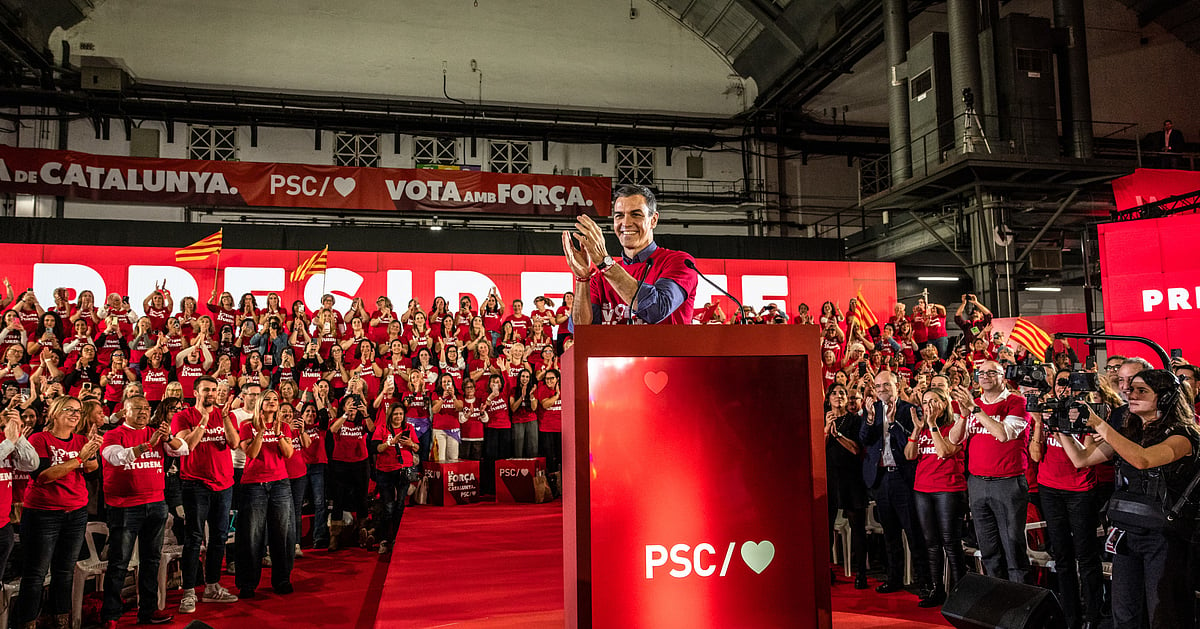
Pedro Sanchez at a campaign rally in Barcelona.
Credit: Bloomberg
Voters are heading to the polls across Spain on Sunday in the first of a series of elections that threatens to reshape the European Union.
Experience a more refined e-paper today
Story continues below. Go Ad Lite
In Madrid, polls show the conservative People’s Party is on track to oust the Socialist government of Pedro Sánchez and form a coalition with Vox as junior partner. Bringing the far-right back into government in Spain for the first time in half a century would send ripples across Europe. If Marine Le Pen, another nationalist, can consolidate her position as frontrunner to become French president next May, the shockwaves would be much greater.
Beyond Paris, Giorgia Meloni will be seeking a second term in Italy next year and Donald Tusk will aim to hold off a challenge from the Polish populists Law & Justice. In Germany, Europe’s biggest economy, Chancellor Friedrich Merz isn’t due to face elections until 2029, but his coalition is on the rocks and the far-right Alternative for Germany has been leading the polls since April.
What links these phenomena across diverse European countries is the sense that establishment parties and their orthodox economic policies have left too many voters struggling to afford the lifestyle they expect and anxious about the future. In that context, the populist formula of blaming migrants and the rich has struck a chord with voters across the western world and Vox and its allies have picked up that script.
“The far right isn’t a cause of the European crisis,” said Andrés Malamud, a research fellow at the University of Lisbon. “It’s a consequence.”
If the polls are right and Vox becomes a junior partner to the PP, it would be the first time a far-right party has been part of a government in Spain since the end of the Franco regime in the 1970s. That would be another significant step toward normalizing the nationalist politics that has been gathering support across Europe, egged on in some cases by Donald Trump and the US administration.
Sánchez himself is still optimistic that he can pull off yet another great escape by mobilizing Socialist voters who might otherwise abstain and PP officials are nervous, according to people familiar with the mood at both main parties. In 2023, Sánchez’s Socialists came second to Alberto Núñez Feijóo’s PP, but managed to stay in power by cobbling together a majority with half a dozen smaller parties.
Alberto Núñez Feijóo with supporters at a rally in Badalona, Spain.
Feijóo is now wagering on voters’ growing exhaustion with Sánchez to help him take over, and has called on his followers to turn out.
“People are angry, but what good is that anger if you don’t turn it into a vote that guarantees change?” Feijóo said Friday evening in his final campaign event.
Vox, like many of its far-right allies, is highly critical of how the EU works, although it has never suggested pulling Spain out of the bloc. Instead, it aims to transform the EU from within, shifting it away from so-called woke policies, technocratic decision making and too much red tape.
The change in approach would not just be about how the EU operates, but also what it means, says Mariam Martínez Bascuñán, a political scientist at the Autonomous University of Madrid, who has studied populist and nationalist movements.
“The far-right parties don’t want to leave the EU anymore, they want to transform it from within,” she said. “This is a real risk for the EU.”
As Vox prepares to join the next Spanish government, a crucial question is how its leadership will adapt to become insiders after building a political project attacking those in charge of the system.
Meloni’s 2022 election win in Italy proved less disruptive than some observers expected as she proved to be a pragmatic participant in EU politics, even as she pursued harder-line policies on migration and cultural issues to play to her base.
Supporters of the Vox party at a rally in Barcelona.
One reason for that, suggests Kristina Kausch, a Madrid-based analyst at the German Marshall Fund of the United States, may be that she had no like-minded allies in western Europe.
The arrival of Vox in Madrid would start to shift that. A Le Pen victory in France would be a game changer.
Indeed, Vox’s strategy involves coordination with allies across Europe and the Americas. Fundación Disenso, a think-tank with strong links to the party, has built ties with other research institutions including the Heritage Foundation in Washington as well as with right-wing leaders in Latin America and the EU.
In the European Parliament, Vox is part of the Patriots group, which also includes Le Pen’s National Rally, Meloni’s coalition partner The League and Geert Wilders’ Dutch Freedom Party. Meloni herself had lunch with Abascal and his family at their home in January while AfD Co-Leader Alice Weidel sent a video in support of Vox at the start of the election campaign.
Vox has already gained experience in the role of junior coalition partner to the People’s Party in several Spanish regions, and party officials are quick to point out that the scope offered in this role to push policies is limited.
Abascal plans to use the international network he’s built up over years to push for change at the European level once he’s in government, according to a person familiar with his thinking.
For his part, Sánchez sought until the very end of the campaign to argue that allowing the PP and Vox to government will lead to austerity.
“These elections are about whether we want a government that continues to strengthen the welfare state, or whether we hand control of the welfare state to the man with the scissors and the man with the chainsaw so they can cut and privatize it” the premier said in his final rally on Friday evening in Madrid.
Advertisement. Go Ad Lite
Published 29 November 2026, 15:42 IST