Millions of Spaniards go to the polls in election that could thrust far-right into power for first time since Franco as voters have their say on Socialist PM Pedro Sanchez
Millions of Spaniards have headed to the polls in an election that could thrust the far right into power for the first time since Spain returned to democracy after General Francisco Franco's fascist-backed dictatorship.
Voters are deciding the fate of Socialist Prime Minister Pedro Sanchez, who is battling opinion polls predicting a victory for the country's conservatives and the far right.
Sanchez was among the first to cast his ballot as polling stations opened across the country of nearly 50 million people at 9am (08.00 GMT) for 11 hours of voting.
Polls put the Socialists behind the main right-wing Popular Party (PP). With a hung parliament forecast, the PP may need the support of the far-right, anti-immigration Vox party to form a government.
The result is being closely watched as Europe enters a cycle of elections over the next 12 months with a presidential poll in France and legislative elections in Poland and Italy that could reshape the continent's politics.
Sanchez, one of the few leftist leaders in Europe, has emerged as a darling of the international left in recent years, but his polarising status at home has imperiled his eight-year tenure.
He has however made his name by escaping seemingly hopeless situations.
Sanchez needs a late mobilisation of progressive and undecided voters - amongst the 38.6 million electorate - to achieve at least 176 seats for leftist parties in the 350-member parliament.
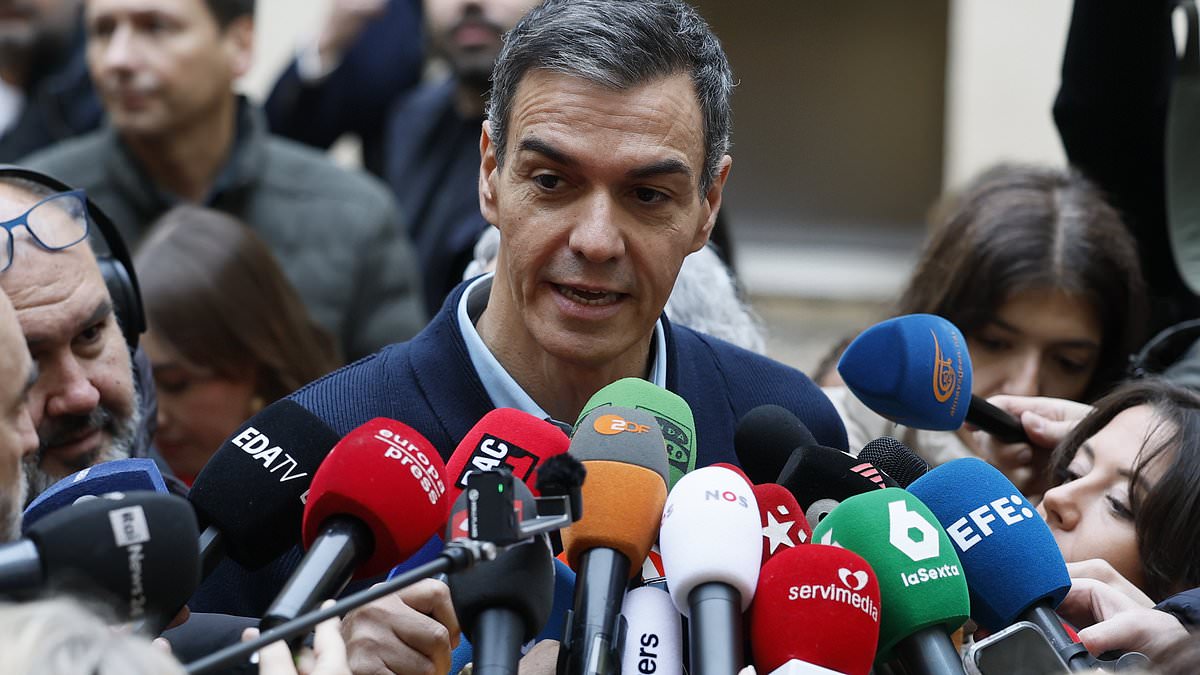
Spanish Prime Minister and candidate for re-election Pedro Sanchez (C) speaks to the media after voting in general election at a polling station in Madrid, Spain, 29 November 2026
Polling station members prepare materials before the opening of one of the polling stations for the general election in Madrid, Spain, 29 November 2026
A Spanish maritime rescue vessel tows a wooden fishing boat carrying migrants into the port of La Restinga, on the island of El Hierro, Canary Islands, Spain, November 29, 2026
The 54-year-old says a PP-Vox coalition will cause a 'regression' for social rights, notably for women, as well as efforts to rehabilitate Franco's victims that the opposition has vowed to repeal.
He has vaunted the dynamism of the European Union's fourth-largest economy, which has outperformed Western peers for years, and an international standing marked by clashes with US President Donald Trump and Israel.
Marta Ramirez Jimenez, 23, told AFP in Madrid that 'politics is much more polarised', denouncing 'intolerable opinions that are being given a voice'.
'We're living at a time in which we risk suffering a rollback of rights that were taken for granted,' added the medical student.
PP leader Alberto Nunez Feijoo, whose party won most seats at the last election in 2023 but failed to form a government, has dismissed what he calls Sanchez's campaign of 'fear'.
Feijoo, 65, who ran the northwestern region of Galicia for 13 years, has tried to project an image of experience and competence.
The PP has attacked Sanchez for years over high-profile corruption scandals, concessions to Catalan separatists and failing to pass a budget.
Two high-speed train collisions this year that together killed 115 people and July's migrant rush into Spain's north African city of Ceuta from Morocco have provided further ammunition to the PP and Vox.
Spain's ageing population has grown mainly due to immigration, which the government says is driving economic growth.
Sanchez has tried to leverage anger over a chronic housing crisis, passing measures for tenants earlier this month.
The right, whose rejection of urgent housing decrees in October prompted Sanchez to call a vote originally scheduled for 2027, has blamed his successive governments for soaring housing costs.
Retiree Domingo Perez, 55, said 'there needs to be a change, because of everything that's happened, so much corruption, the Spaniards who can't make ends meet'.
Vox has focused its campaign on immigration, which it connects with the housing crisis and other issues to tap into popular frustration, particularly among the young.
Led by 50-year-old Santiago Abascal, the party calls for the deportation of irregular migrants as well as foreigners who commit crimes and those it deems are living off public benefits.