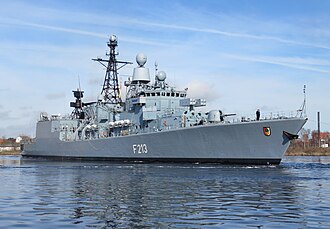
German Frigate Augsburg (F213): History, Design, Armament, and Operational Service
The German frigate Augsburg (F213) was an important warship of the German Navy and one of eight vessels belonging to the Bremen-class frigates, also known as Type 122. Designed during the Cold War to strengthen West Germany’s naval capabilities, Augsburg became part of a generation of versatile surface combatants intended to protect maritime trade routes, escort naval formations, conduct anti-submarine warfare, and provide protection against potential air and surface threats.
Commissioned in October 1989, just one year before German reunification, the ship entered service at a particularly significant moment in European history. The political and military landscape of the continent was changing rapidly, and the German Navy was preparing for responsibilities that extended far beyond the traditional defensive requirements of the Cold War.
Throughout its operational career, Augsburg demonstrated the adaptability that made the Bremen-class frigates valuable assets for the German Navy. Although the ships were originally designed with an emphasis on anti-submarine warfare and escort missions in the North Atlantic and surrounding European waters, the changing international security environment required them to undertake a much broader range of operations.
Augsburg subsequently participated in international maritime security missions, counter-piracy operations, NATO activities, and multinational naval deployments. Its service included operations in the Mediterranean Sea, the Indian Ocean, and other strategically important maritime regions. The vessel was particularly notable for its participation in Operation Atalanta, Operation Sophia, and escort duties connected with the international destruction of Syrian chemical weapons.
Augsburg remained in active service for approximately three decades before being officially decommissioned on December 18, 2019. Its career illustrates the evolution of German naval strategy after the Cold War and demonstrates how a frigate originally conceived for conventional naval warfare could be adapted to meet the demands of international security operations.
More than simply another Bremen-class vessel, Augsburg represented an important chapter in the development of Germany’s post-Cold War naval forces.
Development and Historical Background of the Bremen-Class Frigates
The German Navy During the Cold War
The development of the Bremen-class frigates was closely connected to the strategic requirements of the Federal Republic of Germany during the Cold War. As a NATO member situated on the alliance’s eastern frontier, West Germany had significant responsibilities in protecting the North Sea, the Baltic approaches, and important maritime communication routes in the North Atlantic.
These waters were strategically important because they connected Western European countries with North American allies and provided access to essential commercial shipping routes.
The possibility of a military confrontation between NATO and the Warsaw Pact influenced German naval planning for several decades. Naval forces were expected to monitor maritime activity, protect allied shipping, locate and track enemy submarines, and cooperate with other NATO navies in maintaining control of strategically important sea areas.
Frigates therefore became essential components of the German fleet because they could combine several different military capabilities within a single relatively compact warship.
Earlier German frigates had been designed according to the technological and strategic requirements of the immediate post-war period. However, advances in submarine technology, naval aviation, radar systems, and anti-ship missiles gradually made newer vessels necessary. The German Navy required ships with better sensors, more effective weapons, greater operational flexibility, and the ability to cooperate with modern allied naval formations.
The Bremen-class program emerged as an answer to these requirements. The ships were influenced by the Dutch Kortenaer-class design, although the German version incorporated its own propulsion arrangement, weapons systems, sensors, and aviation facilities. The resulting vessels became some of the most recognizable and successful frigates operated by the German Navy during the late twentieth and early twenty-first centuries.
Introduction of the Type 122 Design
The Bremen-class, officially designated Type 122, consisted of eight frigates constructed between 1979 and 1990. The first vessel, Bremen (F207), entered service in 1982, while the final ship, Lübeck (F214), was commissioned in 1990. Augsburg was the seventh vessel of the class and represented one of the later examples of the original design.
The Type 122 frigates were developed primarily for anti-submarine warfare, escort operations, and maritime security. Nevertheless, their weapons and sensor arrangements gave them the ability to perform anti-aircraft and anti-surface missions as well. This combination of capabilities made the class particularly useful for NATO operations, where frigates frequently had to perform several different tasks during a single deployment.
One of the most important characteristics of the Bremen-class design was its aviation capability. The ships were equipped with a flight deck and hangar arrangements intended to accommodate two Sea Lynx helicopters. These aircraft substantially extended the vessels’ surveillance and anti-submarine warfare capabilities by allowing them to search areas beyond the immediate detection range of their onboard sensors.
The introduction of the Bremen-class represented a significant improvement in the German Navy’s ability to conduct sustained maritime operations. Its vessels were designed not merely as coastal defense ships but as ocean-going warships capable of operating alongside international naval forces.
Construction and Commissioning of German Frigate Augsburg (F213)
Building the Seventh Bremen-Class Frigate
Augsburg was constructed by Bremer Vulkan, a major German shipbuilding company based in Bremen. The vessel was laid down on April 4, 1987, and launched on September 17 of the same year. Following its launch, the frigate underwent the necessary fitting-out work, technical testing, and preparations required before entering operational service.
The construction of Augsburg reflected the established manufacturing standards and technological ambitions of the German naval shipbuilding industry during the 1980s. Its hull, propulsion machinery, weapons arrangements, and electronic systems were designed to provide a balanced combination of speed, endurance, survivability, and combat effectiveness.
The frigate was named after Augsburg, a historic city in Bavaria, Germany. Naming naval vessels after important German cities maintained a long-established tradition and connected the country’s maritime forces with its regional and national identity.
Entry into Service in 1989
The official commissioning of Augsburg took place on October 3, 1989. This date was particularly significant because it was exactly one year before German reunification on October 3, 1990. At the time of its commissioning, Germany remained divided into the Federal Republic of Germany and the German Democratic Republic, and the European security environment was approaching a historic transformation.
Initially, Augsburg was assigned to the 2nd Frigate Squadron. On January 9, 2006, it was transferred to the 4th Frigate Squadron, continuing its service within the German Navy’s operational structure.
The frigate eventually became associated with Wilhelmshaven, one of Germany’s principal naval bases on the North Sea. This location provided convenient access to the North Sea and the wider North Atlantic while supporting the deployment of German naval units to international operating areas.
Augsburg’s pennant number, F213, distinguished it from the other vessels in the class. The ship also acquired the informal nickname “Wilde 13,” a reference to its number and the popular German children’s story associated with the Augsburger Puppenkiste marionette theatre.
Design and Physical Characteristics
Hull Configuration and General Layout
Augsburg was a medium-sized ocean-going frigate with a conventional steel hull and a design optimized for extended naval operations. Its overall length was approximately 130.5 meters, while its beam measured around 14.6 meters. Depending on the reference and measurement configuration, its maximum draft was reported at approximately 6.0 to 6.5 meters.
The ship’s dimensions provided sufficient internal volume for its propulsion machinery, weapons systems, electronic equipment, accommodation spaces, aviation facilities, and operational command areas. Its design reflected the traditional requirements of a multi-role escort frigate: it needed to be large enough to operate in challenging ocean conditions but compact enough to remain economical and manageable within the German naval fleet.
The superstructure accommodated the bridge, command facilities, radar equipment, communication systems, and other essential installations. Weapons were distributed across the vessel to provide effective coverage against different categories of threats, while the flight deck and hangar were positioned toward the stern.
The arrangement of the ship’s systems was particularly important because modern frigates must coordinate numerous activities simultaneously. Navigation, tactical communications, radar surveillance, sonar operations, weapon control, helicopter operations, and machinery management all require specialized equipment and trained personnel.
Displacement and Stability
Augsburg had an operational displacement of approximately 3,680 tonnes. This figure placed it within the medium frigate category and provided a useful balance between seaworthiness, operational endurance, and combat capability.
Displacement is an important characteristic of a naval vessel because it influences stability, internal capacity, fuel storage, payload, and overall performance. For a frigate expected to operate in the North Atlantic and other challenging maritime environments, adequate displacement was particularly important.
The Bremen-class ships were designed to maintain operational effectiveness during extended deployments and in a variety of sea conditions. Their hull dimensions and machinery arrangements supported sustained cruising, while their aviation facilities allowed them to conduct operations that required capabilities beyond those of a conventional surface combatant.
Propulsion System and Performance
CODOG Propulsion Arrangement
One of the most important technical characteristics of Augsburg was its Combined Diesel or Gas turbine propulsion system, commonly abbreviated as CODOG. This arrangement combined diesel engines for economical cruising with gas turbines for high-speed operation.
The system consisted of two MTU 20V 956 TB92 diesel engines and two General Electric LM2500 gas turbines. The diesel engines were intended for routine cruising and situations in which fuel efficiency was more important than maximum speed. When higher performance was required, the gas turbines could be engaged to provide substantially greater propulsion power.
The CODOG arrangement offered an effective solution for a warship that needed both long-range endurance and the ability to accelerate rapidly when operational circumstances demanded it. Instead of operating all propulsion machinery continuously, the ship could select the appropriate power source according to its mission and speed requirements.
The engines transmitted power through reduction gearboxes to two propeller shafts. This arrangement provided the frigate with the propulsion performance necessary for escort operations, fleet maneuvering, and independent deployments.
Speed and Operational Range
Augsburg was capable of reaching speeds of approximately 30 knots, equivalent to around 56 kilometers per hour. This performance allowed it to operate alongside fast naval formations and respond to changing tactical situations.
At lower speeds, the diesel engines provided a more economical operating configuration. This was particularly important during long patrols and surveillance missions, where maintaining an appropriate balance between speed and fuel consumption could significantly influence operational endurance.
The combination of diesel and gas turbine propulsion was one of the defining features of the Bremen-class frigates. It gave the vessels the flexibility to undertake both routine maritime security tasks and more demanding naval operations without requiring a completely different propulsion arrangement.
Weapons and Combat Capabilities
Main Naval Artillery
Augsburg was equipped with a 76 mm OTO Melara Compact naval gun. This weapon was installed in the forward section of the ship and provided a flexible artillery capability against surface targets and selected aerial threats.
The 76 mm gun was widely used by naval forces around the world because of its relatively high rate of fire, compact installation, and ability to engage different target categories. It could support naval patrol operations, provide warning or suppressive fire when required, and contribute to the vessel’s defensive capabilities.
The frigate also received close-range weapons intended to strengthen its ability to respond to threats approaching the ship. These systems complemented the missile armament and provided additional defensive options.
Anti-Ship Missile Systems
Augsburg carried Harpoon anti-ship missiles, which were among the most widely recognized Western naval anti-ship weapons of the late twentieth century. The missiles were designed to engage enemy surface vessels at distances beyond the effective range of conventional naval artillery.
The Harpoon system gave the frigate a significant offensive capability against hostile ships. Its presence also made Augsburg a more versatile escort vessel because it could contribute to the protection of friendly formations while retaining the ability to threaten opposing surface combatants.
The ship’s Harpoon launchers were arranged in two quadruple installations, providing eight launch positions in the commonly documented original configuration. Missile inventories and operational configurations could vary over time.
Air Defense Weapons
The frigate’s air defense capability was based on a combination of NATO Sea Sparrow and RIM-116 Rolling Airframe Missile systems.
The NATO Sea Sparrow system was designed to engage aircraft and other aerial threats. It gave Augsburg a short-range area-defense and self-defense capability appropriate to a frigate of its generation. Its eight-cell launcher could accommodate up to 16 missiles in the ship’s commonly documented configuration.
The RIM-116 RAM system provided an additional layer of close-in defense. Designed to engage incoming anti-ship missiles and other immediate threats, RAM was particularly valuable because modern naval vessels must be capable of responding to threats that may approach with very little warning.
Together, these missile systems provided a layered defensive arrangement. Sea Sparrow offered an engagement capability at greater distances than the close-in RAM system, while RAM provided an additional protective measure against threats penetrating the outer defensive layer.
Anti-Submarine Warfare Weapons
Anti-submarine warfare was one of the central missions for which the Bremen-class frigates were originally designed. Augsburg was therefore equipped with lightweight torpedo launchers and sonar equipment intended to detect, track, and engage underwater targets.
The ship carried two twin 324 mm torpedo launchers associated with the Mark 32 system. These launchers could employ lightweight torpedoes such as the American Mark 46, depending on the ship’s configuration and available inventory.
Lightweight torpedoes were particularly suitable for anti-submarine warfare because they could be launched from surface ships and aircraft. Their use allowed Augsburg to respond to underwater threats identified by its own sensors or by information provided through allied naval networks.
The ship’s anti-submarine warfare capability was further strengthened by its embarked helicopters, which could search a much wider area than the frigate alone.
Sensors, Radar, and Electronic Warfare
Radar Surveillance and Target Detection
A modern frigate requires sophisticated sensors to maintain situational awareness and identify potential threats. Augsburg’s electronic equipment included radar systems designed to detect and track aircraft and surface vessels.
The Bremen-class modernization program introduced more advanced radar capabilities over the ships’ service lives. Public technical descriptions of the class identify the TRS-3D radar among the systems associated with its later configuration.
Radar surveillance was essential for navigation, air defense, surface monitoring, and coordination with other naval units. The ability to identify and track multiple contacts helped the ship’s command team evaluate the maritime environment and respond to developing situations.
Sonar and Underwater Surveillance
Because anti-submarine warfare was a primary design requirement, Augsburg was equipped with a hull-mounted sonar system. The DSQS-21 series is associated with the class and provided the capability to detect and track underwater contacts.
Sonar systems work by analyzing acoustic information transmitted through water. Depending on the operating mode, they can detect sounds produced by submarines and other underwater objects or actively transmit acoustic signals and analyze their reflections.
Underwater surveillance is particularly challenging because environmental conditions, water depth, temperature layers, background noise, and the acoustic characteristics of the target can all affect detection performance.
Augsburg’s sonar equipment was therefore an important part of a wider anti-submarine warfare system that included torpedoes, helicopters, communications equipment, and cooperation with other naval vessels.
Electronic Warfare and Countermeasures
Electronic warfare systems were another important component of the frigate’s defensive equipment. These systems were designed to detect hostile radar emissions, provide information about potential threats, and support electronic countermeasures when necessary.
The Bremen-class ships were associated with the FL 1800 electronic warfare system. The vessels also employed decoy-launching equipment designed to complicate the targeting process for incoming missiles.
Such defensive measures were essential because modern anti-ship missiles could approach at high speeds and leave a warship with only a limited amount of time to react. Electronic warning systems, radar countermeasures, decoys, and close-in missile defenses therefore formed an integrated protective arrangement.
Naval Aviation: The Sea Lynx Helicopters
Two Helicopters for Extended Maritime Operations
One of the most significant advantages of Augsburg was its ability to operate with two Westland Sea Lynx helicopters. These aircraft extended the ship’s operational reach and provided capabilities that could not be achieved through the frigate’s onboard sensors alone.
The Sea Lynx was a naval helicopter developed for maritime operations and widely used by several NATO countries. In German naval service, the aircraft was employed for anti-submarine warfare, maritime surveillance, and other specialized missions.
The helicopters could be equipped according to the requirements of a particular operation. Their potential equipment included lightweight torpedoes, Sea Skua anti-ship missiles in applicable configurations, and machine guns.
The Importance of Helicopter Operations
Helicopters substantially improved the frigate’s ability to search large areas of ocean. In anti-submarine warfare, an aircraft can investigate contacts at a distance from the parent vessel, deploy appropriate equipment, and help establish the location of underwater threats.
They were also useful during maritime security operations because they could observe suspicious vessels, monitor shipping movements, and provide aerial support to boarding teams.
The combination of a frigate and embarked helicopters was particularly valuable during counter-piracy missions. While the ship provided a mobile command platform and logistical support, its aircraft could help locate suspicious activity and improve the crew’s awareness of the surrounding maritime environment.
Operational History and International Missions
Operation Enduring Freedom and Maritime Security
Following the end of the Cold War, Augsburg’s operational responsibilities increasingly reflected Germany’s participation in international security missions. The ship took part in deployments connected with Operation Enduring Freedom in the Horn of Africa and other maritime security activities.
These operations demonstrated the changing role of German naval forces. Instead of focusing exclusively on the defense of European waters against conventional military threats, the navy increasingly participated in international efforts to protect shipping, monitor maritime activity, and counter security threats in strategically important regions.
The Horn of Africa was particularly important because of its position near major international shipping routes connecting Europe and Asia. Commercial vessels passing through the region faced risks associated with piracy, political instability, and other forms of maritime insecurity.
Operation Atalanta in 2013
One of Augsburg’s important operational deployments took place during Operation Atalanta, the European Union’s counter-piracy mission off the coast of Somalia.
The ship participated in the operation from April 3 to August 30, 2013. During this period, it supported international efforts to protect merchant shipping and humanitarian deliveries against pirate attacks.
Operation Atalanta was established to address piracy in the western Indian Ocean and the Gulf of Aden. These areas are important international shipping corridors, and attacks against commercial vessels had become a significant concern for the international community.
Augsburg’s participation demonstrated the usefulness of the Bremen-class design in missions that required prolonged patrols, surveillance, cooperation with international partners, and the ability to respond to suspicious maritime activity.
The 2014 International Training Deployment
On February 11, 2014, Augsburg departed Wilhelmshaven as part of a German naval formation that included the frigates Mecklenburg-Vorpommern and Hamburg, the corvette Oldenburg, and the replenishment ship Frankfurt am Main.
The deployment formed part of the German Navy’s annual training and exercise program. It provided opportunities to improve cooperation between different types of naval vessels and conduct exercises in a variety of maritime environments.
The formation operated over a broad geographical area, with activities extending from the Arctic Circle toward the Equator. During the deployment, the ships visited 13 ports in nine countries before the training period concluded in Kiel on June 20, 2014.
This voyage demonstrated the long-range operational capabilities of the German Navy and the importance of international naval cooperation. It also provided valuable experience for the crews in navigation, logistics, communication, and coordinated operations.
Escorting MV Cape Ray in 2014
One of the most unusual assignments in Augsburg’s career came in April 2014, when the frigate was tasked with escorting the American vessel MV Cape Ray in the eastern Mediterranean.
Cape Ray had been equipped to support the destruction of Syrian chemical weapons as part of an international disarmament effort. The operation was intended to eliminate a stockpile of dangerous chemical materials outside Syrian territory.
Augsburg joined the escort mission on April 9, 2014. Its role was to provide maritime protection for a vessel involved in a highly sensitive international operation.
This assignment demonstrated that the frigate’s usefulness extended beyond conventional military activities. Naval escorts can be essential when civilian or specialized vessels are conducting operations involving dangerous cargo, politically sensitive material, or strategically important missions.
The Cape Ray deployment also illustrated Germany’s contribution to international efforts aimed at reducing the risks associated with chemical weapons.
Operation Sophia and Mediterranean Security in 2015
In November 2015, Augsburg departed Wilhelmshaven with the replenishment ship Berlin to participate in Operation Sophia in the Mediterranean Sea.
Operation Sophia was an EU naval mission established in response to the growing humanitarian and security crisis associated with irregular migration across the central Mediterranean. Its activities included disrupting the business model of human-smuggling and trafficking networks, supporting maritime surveillance, and cooperating with other international organizations.
Augsburg’s involvement demonstrated the flexibility of the frigate in a maritime environment that required surveillance, coordination, and the ability to operate alongside vessels from different countries.
The mission was not a conventional naval confrontation. Instead, it involved a complex combination of maritime monitoring, law enforcement support, international coordination, and humanitarian considerations.
Escorting the French Aircraft Carrier Charles de Gaulle
A particularly important chapter in Augsburg’s operational history began in December 2015, when it joined the French aircraft carrier Charles de Gaulle and its associated naval formation.
On December 6, 2015, Augsburg began escort duties supporting the French carrier during operations against the Islamic State organization in Iraq and Syria.
Operating with an aircraft carrier strike group required effective coordination between different naval units. Aircraft carriers are powerful military platforms, but their protection depends on escort vessels that provide surveillance, air defense, anti-submarine warfare, and other supporting capabilities.
Augsburg contributed to the multinational formation by performing escort and maritime security duties. Its participation continued until March 11, 2016, after which the frigate returned to Wilhelmshaven, arriving on March 24.
The crew was awarded the French Overseas Medal in recognition of its service during the deployment.
Augsburg subsequently redeployed to the Mediterranean in August 2016 and again operated alongside the Charles de Gaulle carrier group. The ship left the carrier formation on November 14 to undertake further patrol activities.
During this deployment, it also spent four days participating in NATO’s Operation Sea Guardian, which focused on maritime security and situational awareness in the Mediterranean.
The frigate returned to Wilhelmshaven on November 25, 2016.
Final Operational Deployments in 2018 and 2019
Augsburg continued to participate in international maritime activities during the final years of its service. On September 17, 2018, it departed Wilhelmshaven to replace the replenishment vessel Mosel in Operation Sophia.
This deployment was another example of the vessel’s ability to support international missions in the Mediterranean. The frigate’s surveillance equipment, communication systems, helicopters, and onboard facilities made it suitable for operations requiring a persistent maritime presence.
By this stage, however, Augsburg was approaching the end of its operational life. After approximately three decades of service, the vessel was becoming part of an older generation of German naval equipment that was gradually being replaced by newer frigates.
Decommissioning and the End of Service
Official Retirement in December 2019
Augsburg was officially decommissioned on December 18, 2019. Its retirement marked the end of a naval career that had begun during the final years of the Cold War and continued through a period of major international political and military change.
The frigate had served the German Navy for approximately 30 years. During that time, it experienced the transformation of German naval strategy from a primarily regional NATO defense role toward a broader international security mission.
Its service record included conventional training exercises, multinational naval deployments, counter-piracy operations, Mediterranean maritime security missions, and carrier escort duties.
Replacement by Newer German Frigates
The retirement of Augsburg formed part of the gradual withdrawal of the Bremen-class vessels from German naval service. The class had provided the German Navy with a reliable and adaptable fleet of frigates for several decades, but its original technology and equipment were increasingly outdated compared with newer naval designs.
Successive generations of German frigates introduced improved radar systems, more sophisticated command facilities, advanced missile capabilities, and enhanced operational flexibility.
The Brandenburg-class, Sachsen-class, and Baden-Württemberg-class frigates represented important stages in the modernization of Germany’s surface fleet.
The final Bremen-class vessel, Lübeck (F214), was decommissioned on December 15, 2022. With its retirement, the operational history of the Type 122 frigates in the German Navy came to an end.
The Historical Importance of German Frigate Augsburg
Augsburg’s significance cannot be measured solely by its weapons, displacement, or maximum speed. Its real importance lies in the way it represented the changing responsibilities of the German Navy over three decades.
When the vessel entered service in 1989, its primary purpose was connected with the conventional maritime defense requirements of the Cold War. By the time it was retired in 2019, it had participated in international operations involving counter-piracy, maritime security, multinational naval cooperation, and the protection of strategically important shipping routes.
Its deployments demonstrated that a well-designed frigate could remain useful even as international security priorities changed. The Bremen-class vessels were not originally developed specifically for counter-piracy missions or Mediterranean migration-related operations, yet their combination of endurance, sensors, helicopters, and defensive weapons allowed them to undertake these responsibilities.
Augsburg also demonstrated the importance of international cooperation in modern naval operations. Its participation alongside American and French vessels, as well as its involvement in European Union and NATO missions, illustrated how maritime security increasingly depended on cooperation between allied countries.
The vessel’s history is therefore closely connected to the wider transformation of Germany’s armed forces after reunification. It represents the transition from a military structure focused primarily on defending national and alliance territory toward a force capable of contributing to international operations in distant maritime regions.
Conclusion
The German frigate Augsburg (F213) was one of the important vessels of the Bremen-class and a significant component of the German Navy for approximately three decades. Constructed by Bremer Vulkan and commissioned on October 3, 1989, it entered service at a historic moment immediately preceding German reunification.
Its balanced design combined a powerful CODOG propulsion system, a comprehensive weapons arrangement, radar and sonar equipment, electronic warfare systems, and the ability to operate two Sea Lynx helicopters. These capabilities made it suitable for anti-submarine warfare, escort operations, maritime surveillance, and a wide variety of international naval missions.
Throughout its career, Augsburg participated in Operation Enduring Freedom-related activities, Operation Atalanta, Operation Sophia, and NATO maritime security operations. It also escorted MV Cape Ray during the international destruction of Syrian chemical weapons and supported the French aircraft carrier Charles de Gaulle during operations against the Islamic State organization.
The vessel’s decommissioning on December 18, 2019, brought an end to a career that had spanned one of the most transformative periods in modern European history. Although Augsburg is no longer an operational warship, its service remains an important example of the adaptability, versatility, and international role of the German Navy’s Bremen-class frigates.
Technical Specifications of German Frigate Augsburg (F213)
The following table summarizes the principal technical characteristics and equipment associated with Augsburg and the Bremen-class design. Some equipment details reflect the class configuration and modernization during its operational lifetime.
| Specification | Details |
|---|---|
| Ship name | Augsburg |
| Pennant number | F213 |
| Country | Germany |
| Navy | German Navy (Deutsche Marine) |
| Ship type | Guided-missile frigate |
| Class | Bremen-class |
| Designation | Type 122 |
| Builder | Bremer Vulkan, Bremen |
| Laid down | April 4, 1987 |
| Launched | September 17, 1987 |
| Commissioned | October 3, 1989 |
| Decommissioned | December 18, 2019 |
| Length | 130.5 m |
| Beam | 14.6 m |
| Draft | Approximately 6.0–6.5 m |
| Displacement | Approximately 3,680 tonnes |
| Propulsion | CODOG |
| Main engines | 2 × MTU 20V 956 TB92 diesel engines |
| Gas turbines | 2 × General Electric LM2500 |
| Propulsion power | Approximately 38 MW |
| Propellers | 2 |
| Maximum speed | Approximately 30 knots |
| Main gun | 1 × 76 mm OTO Melara Compact |
| Secondary guns | 2 × 27 mm naval guns in later class configurations |
| Anti-ship missiles | Harpoon |
| Surface-to-air missiles | NATO Sea Sparrow |
| Close-in missile defense | RIM-116 RAM |
| Torpedo launchers | 2 × twin 324 mm launchers |
| Torpedoes | Mark 46 lightweight torpedoes |
| Radar | TRS-3D (class modernization configuration) |
| Sonar | DSQS-21 series |
| Electronic warfare | FL 1800 series |
| Helicopter capacity | Up to 2 Sea Lynx helicopters |
| Standard crew | Approximately 200–219 personnel, depending on configuration |
| Primary missions | Anti-submarine warfare, escort, air defense, maritime security |
| Homeport | Wilhelmshaven, Germany |
| Final status | Decommissioned |
Technical reference: German Federal Ministry of Defence and Bundeswehr publications on the Bremen-class frigates.