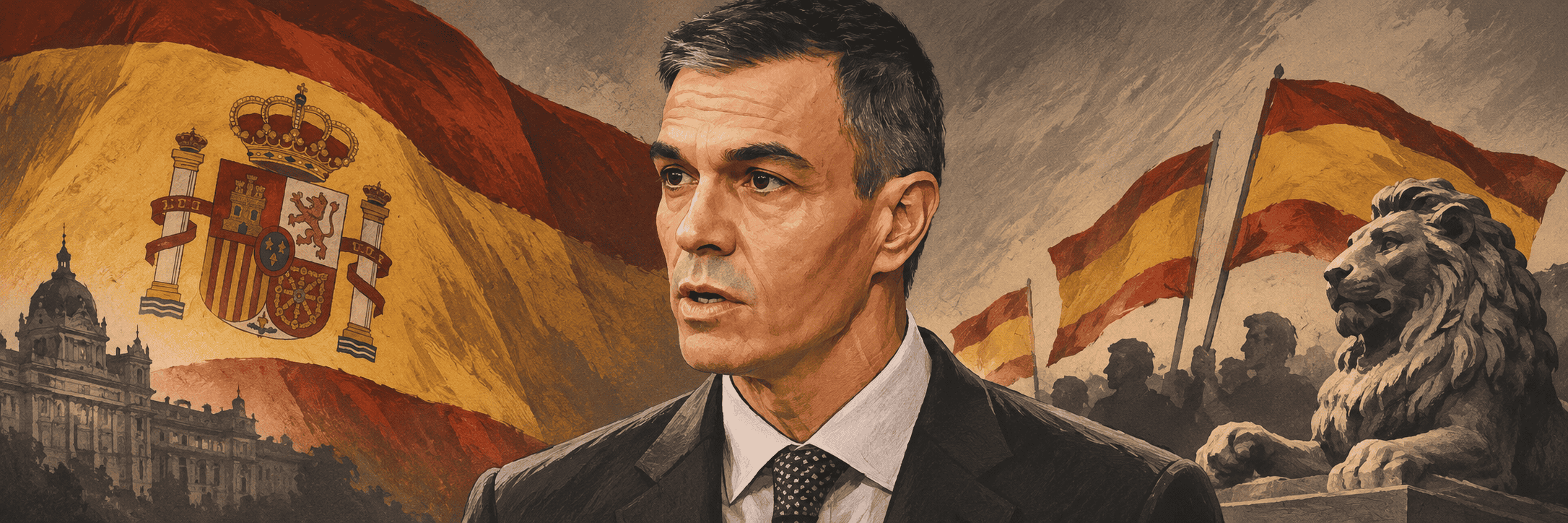
For the first time in my memory, there is no dancing at Spanish election campaign rallies, no candidates cracking jokes, and not even a hint of the typically Spanish pre-election camaraderie in the streets. The only person who keeps dancing at rallies is Pedro Sánchez. Neither his communist and nationalist governing partners nor, of course, the opposition seem to be in any mood for celebration.
There is a level of seriousness and tension in this election campaign that I have never witnessed before.
The U.S. midterm elections, with their Democratic victory, seem to have followed a path opposite to the one currently seen in Europe, where conservative forces are overtaking leftist parties in the polls. Spain will hold general elections on Nov. 29, and all forecasts suggest that the right — combining the PP and VOX — will strip the absolute majority from the left-wing coalition that has kept Pedro Sánchez firmly in power for the past eight years.
The four main options before the Spanish electorate are: the reelection of socialist Pedro Sánchez (PSOE) as prime minister; Alberto Núñez Feijóo (PP), representing the center-right; Santiago Abascal (Vox), representing the right; and communist Ada Colau (Frente Amplio).
No absolute majority is expected; therefore, if the numbers work out in his favor, Sánchez would likely govern once again in a coalition with communists and nationalists, while Feijóo, should he win, would need to reach an agreement with Vox. (READ NEXT: Sánchez Calls Early Elections in Spain: ‘Pour Me Another Whisky!’)
On Nov. 29, Spain will serve as a small-scale electoral laboratory for Europe.
The Spanish elections are drawing particular international interest this time, as the rise of the right is not unique to Spain; it is also occurring in countries like Germany and France, while in Italy, conservatives have been in power since 2022.
The reasons for this broad conservative surge are, in many respects, the same across several European nations: problems stemming from mass immigration and a growing sense of insecurity; high taxes; inflation and the difficulty of accessing housing; and the erosion of national sovereignty and identity in the face of the multicultural globalism promoted by organizations such as the EU or the U.N.
— a subject I addressed in my book, I Will Not Eat Crickets: An Angry Satirist Declares War on the Globalist Elite. (READ NEXT: Welcome to the Far Right)
In this context, the defeat of the Republicans in the United States is being interpreted in Europe as a paradigm shift, following years of the rise of what the Left calls “European Trumpism” — referring, in particular, to burgeoning new-right forces such as Vox in Spain, Chega in Portugal, and the Rassemblement National (National Rally).
In his rallies, Sánchez is already citing the American elections and Lula’s victory in Brazil as examples to follow in order to “dismantle the far-right wave in Spain” — to use his own, somewhat imprecise, phrasing. (READ NEXT: What Happened in Brazil on Sunday Was Absolutely Outrageous)
A month ago, it was already clear that the Spanish prime minister was heading toward the elections facing immense difficulties: a major crisis in his popularity ratings and a complex web of legal entanglements — including corruption cases involving his former associates and his own family. However, the train accident in Urda, Toledo, on Oct. 28 — which left nearly 70 dead and hundreds injured — marked a turning point in his electoral strategy.
It was the second serious, fatal railway accident in the country within 10 months, occurring against the backdrop of a national crisis in infrastructure maintenance, characterized by countless operational incidents, minor accidents, and numerous public complaints from railway professionals.
Following a collapse in the Socialists’ polling numbers in the wake of the accident, the minister of transport was forced to resign — a desperate attempt to salvage the image of Pedro Sánchez’s government. (READ NEXT: Spain Has Had Enough)
At the same time, the government is grappling with widespread social discontent fueled by housing shortages and exorbitant housing prices. Rent caps, a permissive attitude toward the “squatter” movement, and the demonization of property owners have led to a massive withdrawal of housing units from the rental market — further shrinking an already scarce supply.
Labor unions — all of which are aligned with the political left in Spain — called for an unexpected general strike on Nov. 11, following eight years of striking silence. It is worth noting that these organizations have received vast sums of public funding during Sánchez’s tenure. The strike was scheduled for Nov. 11 because the election campaign was set to begin immediately afterward; under Spanish law, strikes are prohibited in the days leading up to an election.
Although the official reasons for the strike were to advocate for decent housing and higher wages, the organizers made no secret of the fact that the true objective was to protest the possibility of the right wing coming to power on Nov. 29. This marks a historic milestone, as it is the first time in Spain that trade unions have mobilized for a general strike — not against the government, but against the opposition.
On Nov. 29, Spain will serve as a small-scale electoral laboratory for Europe. Countries such as France, Italy, and Germany will face elections in the near future, and it remains to be seen whether pressure from the streets — exerted by an alliance of leftist forces, trade unions, and immigrant groups — can halt the rightward shift currently gaining momentum in these nations.
Once again, the broader European context is significant. With cars being set ablaze, electronics stores looted, and demonstrations escalating into violent attacks on the police, the heart of Europe is experiencing a period of intense tension. Over the last few weeks, France, Italy, and Spain have all witnessed civil unrest and street-level vandalism.
Furthermore, within a 30-day window, general or partial strikes have been — or will be — called in Italy, France, Ireland, and Greece, in addition to the one in Spain. Meanwhile, on Nov. 3, the EU once again urged citizens to prepare a mysterious emergency kit — designed to ensure self-sufficiency for three days — in anticipation of a potential international crisis. (READ NEXT: The French Revolution of the 21st Century: From the Guillotine to the Suicide Vest)
Too many strange things have been happening in the Old Continent over the last few days: multiple simultaneous bomb threats forcing the diversion of aircraft; the evacuation of thousands of schools in Italy and Spain for the same reasons, along with the closure of public facilities; a proliferation of cyberattacks; and governments issuing security alerts without specifying the nature of the enemy or the risk.
Regarding the recent unrest in Paris, Milan, and Barcelona, it is worth noting that these events share several common elements: gratuitous violence, destruction, looting of shops, mobilization via social media under the mysterious banner of “Blocus,” the use of far-left and anarchist slogans, and a significant presence of young immigrants of Islamic background among the protesters.
France, Italy, and Spain also share similar migration challenges and political landscapes — specifically, the issue of an excess of irregular immigrants of Arab origin, alongside a growing trend toward the rise of conservative parties belonging to the “new right” (or what the European mainstream media, rather indiscriminately, labels the “far-right”). (READ NEXT: Europe’s Hard Left at Its Most Dangerous)
Furthermore, a potential change of government in Spain would have significant international repercussions regarding the country’s stance toward the United States and Israel, and would likely set a precedent for the rest of the EU. Sánchez positioned himself as Donald Trump’s primary adversary and has repeatedly snubbed Israel — leading the opposition to frequently accuse him of antisemitism.
His stance stands in stark contrast to that of Vox leader Santiago Abascal, who, during a prime-time interview on Televisión Española on Nov. 9, once again defended Israel and denounced the crimes committed by the terrorist organization Hamas.
As for the United States, the most serious diplomatic conflict arose in March 2026, when Sánchez prohibited the U.S. from using its military bases on Spanish soil for operations against Iran. Furthermore, Sánchez is engaged in a prolonged war of words with Trump over his refusal — and failure — to increase military spending, as the United States has demanded of the entire EU.
Finally, Sánchez retains in his government communist and antisemitic ministers who have openly promoted actions against Israel, including boycotts of products, the withdrawal of investments, and the severing of diplomatic relations.
A change in government would almost certainly usher in a new phase of cooperation and normalcy in relations between the United States and Spain, a position that would, in turn, carry greater weight within the EU, while also normalizing relations with Israel.
However, Sánchez has not yet lost the election; he has a long track record of pulling off strange, unexpected victories, such as in 2019, when he opted for a post-election agreement with the communist party Podemos (despite having sworn during the campaign that he would never do so) to remain in power, even though the PP had won more votes than his party.
Perhaps for this reason, the entire opposition has warned of the risk of electoral fraud and has urged citizens to avoid voting by mail whenever possible. Against this backdrop, the Supreme Court tried to put the brakes on the “Grandchildren’s Law” — a government-driven initiative for mass naturalization. Many of these distant descendants of Spaniards have never set foot in Spain, nor do they have any genuine ties to the country.
(READ NEXT: Spain’s Sánchez Compiles Blacklists of Journalists and Tries to Tamper With the Electoral Roll)
The Supreme Court questioned the criteria used by the government to grant them citizenship, as well as its impact on the electoral roll and on voting from abroad, and prohibited their ballots from being placed in the ballot boxes set up at consulates. However, as the Spanish press is documenting, the government defied the Supreme Court and ordered the installation of parallel cardboard ballot boxes to store the votes of those who cannot legally vote.
Newspapers such as Libertad Digital are reporting countless complaints of irregularities and chaos in mail-in voting and voting from abroad.
There are many things that Pedro Sánchez appears to be introducing for the first time. This is the first time a law — the so-called Grandchildren’s Law — has been enacted to add large numbers of foreign nationals to the electoral roll ahead of an election, on the grounds that their grandparents or great-grandparents allegedly left Spain because of the Spanish Civil War.
It is also the first time that a palpable sense of deep distrust in the electoral process has permeated the atmosphere. We are seeing massive queues at consulates for the purpose of voting for the first time. Furthermore, this is the first time the Spanish opposition has warned of the risk of electoral fraud. Sánchez himself has played the same card, claiming that the PP and Vox will attempt to challenge the electoral process if they lose.
This is an extraordinary situation in this part of the world, where, despite the high stakes of the contest, the integrity of the electoral process had never before been called into question. It is also true that Spain has never before had a prime minister accused of electoral fraud in his own party’s primary elections, as Sánchez was when he rose to the leadership of the PSOE in 2017.
And there are more “firsts” under Sánchez. It is the first time that the spouse of a prime minister has been placed under judicial investigation for alleged crimes of influence peddling and corruption; the first time that a prosecutor general has been investigated and subsequently convicted of a criminal offense; and the first time that the brother of a sitting prime minister has been convicted of crimes related to his employment in the public administration.
It is also the first time that a political party, the PSOE, has gone into an election with two consecutive Secretaries of Organization having ended up in pretrial detention over alleged corruption cases, both appointed by Sánchez.
The campaign is about to conclude, and the polls predict that the combined forces of the right — the PP and Vox — could reach 195 seats (they only need 176, the absolute majority required to govern in Spain). Every poll, that is, except for one: the survey from the Center for Sociological Research (CIS).
This government-dependent body is headed by a director appointed by Sánchez — a veteran socialist sociologist and frequent collaborator with the PSOE — and has since lost all credibility. Once again, the CIS stands in stark contrast to dozens of private polling firms by predicting a victory for the left — a forecast that the opposition has greeted with derisive laughter.
The discrepancy between the CIS poll and all the others has an explanation: following the arrival of the director appointed by Sánchez, the CIS modified its polling methodology, implementing a system named after the director himself that gives an inexplicably high weight to “vote recall” — that is, what respondents remember having voted for in the last election. The PSOE victory predicted by Sánchez is much closer to “bandwagon effect” tactics than to polling science.
This is a technique first researched in the United States in 1937 by sociologist Claude E. Robinson, who explained how the publication of election polls could trigger a stampede of voters toward the candidate presented as the frontrunner.
At a time of growing tension and political upheaval throughout the West, Spain’s general election on Nov. 29 will be closely scrutinized by many other nations, as what is at stake appears to be far greater than simply which individual will be chosen to take the helm of my country for the next four years.
Four more years of “social-communism” would be too much for Spain… and for Europe.
READ MORE from Itxu Díaz:
Brainstorming Ideas for a Fun Thanksgiving Dinner (Without Talking Politics)