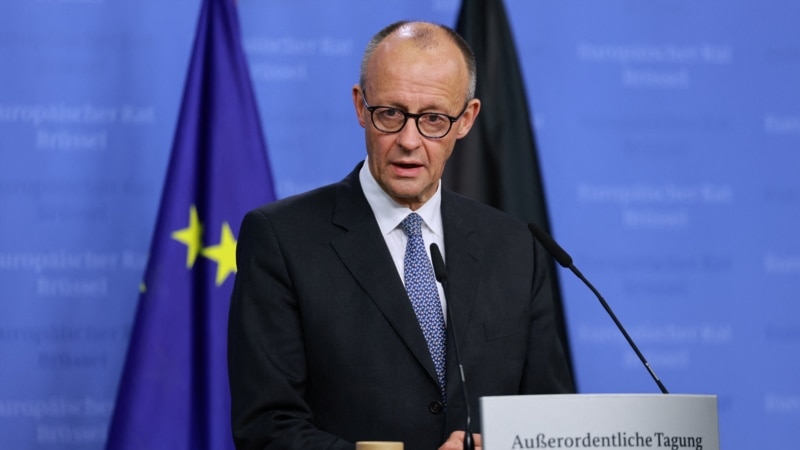
German Chancellor Friedrich Merz said he sees signs of a possible compromise on financing for Ukraine among all European Union member states, although no agreement has yet been reached.
He made the comments on the evening of November 26 at a press conference following an extraordinary EU summit in Brussels, a Radio Free Europe/Radio Liberty correspondent reported.
Leaders of the 27 EU member states had been trying at the meeting to agree on the bloc's seven-year budget for 2028-2034, which sets aside 100 billion euros for Ukraine, as well as additional aid for Ukraine in 2027 worth 45 billion euros.
Merz said there was still no agreement, but that there were signs some of those who remained somewhat hesitant about funding aid to Ukraine from the EU budget had ideas about how that financing could be distributed and how domestic political needs might be taken into account. He said he was maintaining his own position that aid to Ukraine should be guaranteed by the whole European Union.
The chancellor was responding to a question about whether individual states contributing only to the non-military part of a new loan to Ukraine could offer a path to compromise.
Which countries are holding back
Hungary, Slovakia and the Czech Republic have expressed reluctance to help fund Ukraine. All three also received an exemption and did not take part in the EU's previous 90 billion euro loan covering 2026-2027.
Bulgaria had also previously voiced reluctance to guarantee the additional loan. This time, however, its prime minister, Rumen Radev, expressed willingness to join the financing of the non-military part of the loan, worth 20 billion euros. He stressed, though, that Bulgaria would not give money for arming Ukraine.
Merz said he would continue discussing the matter with individual European leaders and would return to it at the summit in December.
Push for qualified majority voting
Merz also argued that future decisions on long-term financing for Ukraine from the EU budget should be able to be taken by a qualified majority of member states rather than requiring unanimity.
He said Europe needed to strengthen its economy and guarantee its security, and that this required a reserve, for example to be able to fund Ukraine over the long term. He said everyone should take part in that, and that decisions should in future be made by qualified majority.
Such a mechanism would allow relevant decisions to be taken without the agreement of every single member state. Under current EU rules, decisions on financing for countries outside the bloc must be taken unanimously. Changing that decision-making mechanism itself would also require unanimity, which does not currently exist.
Germany's leverage in the talks
One of Germany's levers of influence in the negotiations is the requirement that the EU's multiannual budget, to which it is the largest financial contributor, be approved unanimously.
Merz said Germany pays roughly a quarter of the European budget but gets back directly only about 8 percent of the funds, and even less when it comes to so-called cohesion policy funding.
He said he expected the proposed size of the seven-year budget to be reduced, even as a number of less wealthy countries want it increased.
What happens next
Merz said he had not expected a final agreement to be reached at this summit, calling the lack of a result unsurprising and saying he had not expected otherwise.
He said he was instead counting on a deal being reached by the end of the year, saying that everyone wanted to be home for Christmas.
Leaders of the 27 EU member states at the extraordinary summit in Brussels on November 26 did not reach a final agreement on giving Ukraine the additional 45 billion euro loan for 2027. The multiannual budget, together with financing for Ukraine, is expected to be adopted in December.
What happens next
Merz said he will keep discussing the issue with individual European leaders and return to it at the EU summit in December, when the multiannual budget and Ukraine financing are expected to be adopted.
Test yourself
- Who is the German chancellor quoted discussing a possible EU compromise on Ukraine funding?
- How much additional aid for Ukraine in 2027 was under discussion at the summit?
- Which leader offered to help fund the non-military part of the loan while ruling out money for weapons?
Have your say
Should the EU make long-term funding decisions for Ukraine by qualified majority instead of unanimous agreement?
Where it happened
Brussels, Belgium