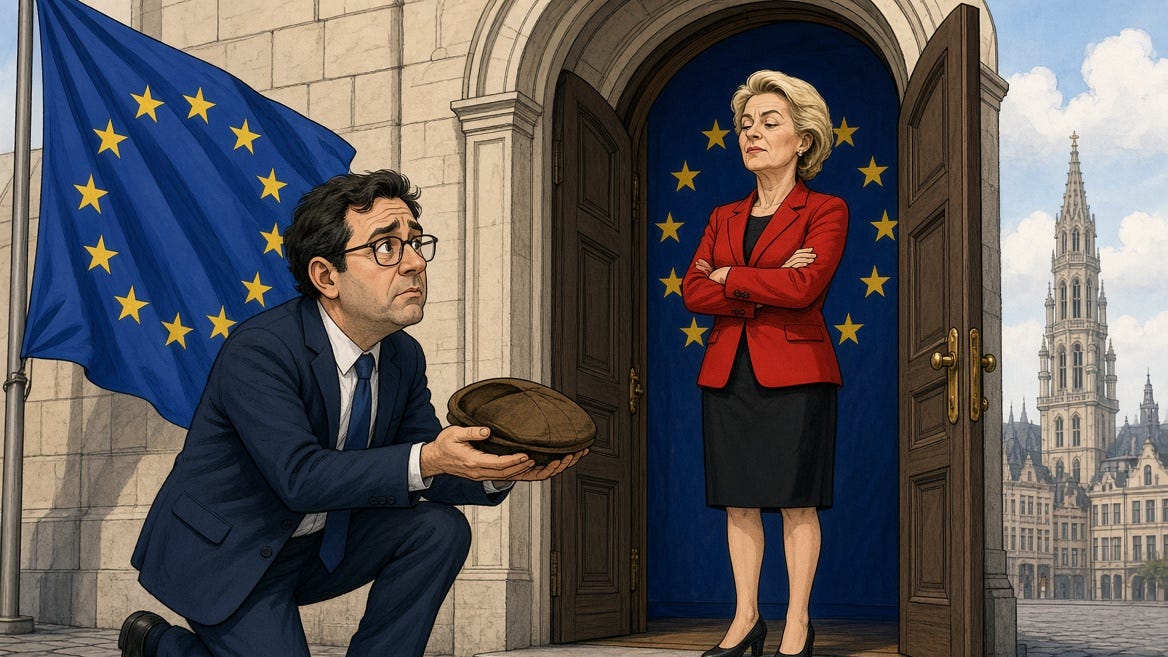
Grok rendition
Andy Burnham told MPs in October that failing to pursue closer ties with Brussels would be a “dereliction of duty”. In Brussels on Friday, he sealed deals on food exports, a link between the two emissions-trading schemes and a youth experience scheme, and hailed a “landmark”. The Prime Minister still insists he is bound by the 2024 manifesto, which ruled out re-entry to the customs union, the single market and freedom of movement. Technically, the red lines are intact.
In substance, Britain has agreed to take the rules of the single market one sector at a time, with no vote on their content. It is membership by instalments, and the instalments are the point.
Those who voted Leave were promised a Britain free to make its own way in the world economy, a “Singapore on the Thames”. Instead, under both parties, Westminster treats subservience to an unelected European Commission as the height of its aspiration. Burnham has said that the most ambitious option would be to go “all the way” and rejoin. He has judged, for now, that the country will not swallow that, so the strategy is to deliver the substance without the label.
Rule-taker by instalments
What was sealed is not trivial. As Deloitte’s tax team explained when the idea was first floated, the common food-standards area works by having the UK align with EU rules, while linking the carbon markets converges British and EU carbon prices.
Labour’s negotiators conceded that 36 agricultural pesticides now authorised in Britain must be banned, and the UK has agreed to align with rules that forbid ‘meaty’ names on non-meat products, a list of 31 terms from bacon to steak, which puts smoky bacon crisps on the endangered list.
Reports before the summit said the Prime Minister would also accept EU rules on Net Zero and higher tariffs on Chinese vehicles, and was expected to present a migration pact with the bloc, though none featured among the three deals announced.
Take the pesticide ban. A British farmer’s crop protection is now decided in a Commission committee room staffed by green ideologues and by officials who don’t answer to him, and the same goes for the smoky bacon crisp. The food deal alone will have Britain adopting at least 780 pieces of ‘in-scope’ EU law a year (roughly two a day), affecting everyday matters from food standards and consumer prices to business costs and household budgets.
This is what ‘dynamic alignment’ means: when Brussels changes a rule, Britain changes with it. Even a defender of the arrangement concedes that it could include provision for UK law to adapt automatically whenever new EU rules are made. The mechanism is the ‘Henry VIII power’, which lets ministers rewrite UK law by statutory instrument, with little debate and no power for MPs to amend it.
The reset bill would let ministers use secondary legislation to automatically adopt EU food safety, animal welfare and pesticide standards. Brexit campaign groups accused Starmer’s government of using Henry VIII powers to reverse Brexit by stealth. Ministers insist that Parliament will have a role in approving new EU laws applying under the deals, but it would be approving rules it cannot change.
The European project increasingly resembles policy-making in the late stages of the Soviet Union, designed by an unelected central bureaucracy in Brussels while elected national assemblies supply the theatre. Westminster keeps the mace but loses the sovereignty that it is meant to symbolise.
Carbon, electricity and the Net Zero ratchet
Linking the UK Emissions Trading Scheme to the EU’s would, according to a new analysis by David Turver, push British carbon prices up by around 32% to converge with higher European levels. The same analysis says that participation in the EU electricity market, which is the logical next step, would require dynamic alignment, acceptance of the European Court of Justice as arbiter of disputes and contributions to EU funds.
Britain would also be tied to an EU target of 42.5% renewable energy by 2030, which is unachievable on current trajectories.
None of this should surprise anyone who read the small print of the Starmer reset. In May 2025, I warned (along with other critical observers) that linking the two carbon markets would expose UK firms to EU regulatory oversight, potentially including European Court of Justice supervision, and that the supposed prize, exemption from the EU’s carbon border tax, was a fig leaf.
The Common Understanding then required Britain to match emissions constraints that are “at least as ambitious” as Brussels’s own and to pay towards the costs of running the scheme. What was a Starmer promissory note has become a Burnham contract, and ETS2, which extends carbon pricing to home heating and road fuel, is still to come.
At home, Burnham tinkers with Net Zero at the edges when it suits him. His Government is softening aviation fuel quotas and preparing to cut electric-vehicle quotas, and it has approved a North Sea gas field. Yet he has backed an energy bill that would write the ban on new exploration into law. The pragmatic noises are for domestic consumption, while the binding commitments are made in Brussels. That is the real constitutional point.
Domestic Net Zero policy can be reversed at an election. A carbon-market link and a standing duty to track EU rules cannot, and whoever wins the next election inherits a rulebook written in another capital.
Fertiliser: farmers pay Brussels’s carbon price
Farmers were promised less friction at the border. They were not told what linking carbon markets does to the one input no arable farm can do without. Britain’s Carbon Border Adjustment Mechanism is due to start on January 1st 2027 and covers fertiliser, and the National Farmers’ Union’s own modelling found that fertiliser makes up 12% of total farm costs and almost 40% of crop-specific spending, with arable farms hit hardest.
Research in the Journal of Agricultural Economics concluded that phasing out free carbon allowances alongside a border levy of this kind would double mineral fertiliser prices and cut farm incomes by up to 8%, although the Government says it expects the initial impact to be modest. Brussels offers no comfort.
France and Italy have asked fellow agriculture ministers to suspend the EU’s own carbon border levy on fertiliser, because the cost lands on farmers while the scheme shields fertiliser producers. Britain, which imports most of its fertiliser, faces a border levy of its own from January and, unless the carbon-market link brings a mutual exemption, would add the Commission’s higher carbon price to it, with no say in how Brussels sets either the price or the rules.
The NFU, which represents 43,000 farm and grower businesses in England and Wales, told a parliamentary committee that it would have preferred an agreement built on mutual equivalence rather than dynamic alignment. That advice did not carry the day.
Punishing our own, pleasing Brussels
Consider how the same Government treats its own producers. ‘Mad Ed’ Miliband has been promoted to Foreign Secretary, and his successor at energy is Miatta Fahnbulleh, who is afflicted by the same economic and energy illiteracy as her predecessor. Chancellor John Healey has kept the 38% windfall tax until 2030, and the ban on new licences stands.
On Wednesday, EnQuest announced it is selling its North Sea assets for up to $960 million, calling the basin “high-tax, low-return”, and BP is already selling its own. Having driven out its producers, Britain imports gas instead, and pays among the highest electricity prices in the industrialised world. Starmer’s 2025 reset, meanwhile, gave EU fishermen a 12-year extension of access to British waters.
A leaked draft of the summit statement had Burnham welcoming it, with no plan to revisit it. What kind of ruling class punishes its own citizens to win applause from Brussels? Burnham, being more presentable than a wooden Starmer, is the more dangerous for it.
A sovereign city, a subject countryside
Burnham has refused dynamic alignment of financial services regulation, preserving the City’s independence from Brussels – likely because London’s powerful bankers would not tolerate such a threat to their interests. If rule-taking were harmless, there would be no reason to spare the City. London’s service exporters keep their autonomy, while farmers and manufacturers in the places that voted Leave get Brussels.
The “Makerfield test” that Burnham promised has an obvious answer: polling found that voters in his own constituency oppose the compromises at the heart of the reset. Reform UK’s Richard Tice accused him of “trying to sneak us back into Brussels via the back door”, and Nigel Farage called his remarks on free movement “a total betrayal” of Brexit Britain.
Kemi Badenoch’s Conservative Party has opened the door to closer cooperation with Reform to block any move back towards the EU. When parties that disagree about almost everything find common cause, the Government should ask what it has misread.
Defenders of the EU ‘reset’ have a ready answer. Alan Dashwood and Jonathan Faull argue that a Swiss-style mechanism would preserve the international-law character of the relationship. In other words, Britain is not subject to EU law; it merely agrees by treaty to copy it. That is a distinction without much difference. A treaty obliging one party to mirror another’s legislation as it evolves is a subordinate relationship whatever its label.
The question is who writes the rules, who settles disputes and who can change them, and the answer is Brussels. These questions are what sovereignty consists of.
A continent in decline
While Burnham genuflects in Brussels, the powers that matter met in Shenzhen. Xi Jinping hosted Trump and Putin for a three-way summit, with the EU having been sidelined into geopolitical irrelevance. Britain’s chosen partner is a bloc without a seat where the world order is being set, led by officials like Kaja Kallas and Ursula von der Leyen, whose policies make little sense to people trying to heat their homes and afford groceries.
We look at the Aztecs with wonder at their sacrifices to the sun god. Future historians may look at Britain and Western Europe with the same incredulity at a ruling class willing to sacrifice its own citizens to a green ideology that ignores the constraints of physics and economics.
The economic case is thin and distant. Burnham says the package could add 0.4% to GDP, about £17 billion. Number 10 has since told reporters that the full benefit, put at 0.5%, will not arrive until 2040, 14 years from now. The food deal alone is put at £5.1 billion a year by 2040. The costs arrive first: higher carbon prices, pesticides banned and a flow of EU rules to follow.
The food-standards element of the original reset could thus cost more than the Government’s own estimate of its benefit.
The pause Burnham has announced is not a retreat. He conceded that the deal is likely the limit of what can be achieved this parliament, yet he also promised an “informal brainstorming” with the EU over the next year, with options ranging from the status quo to joining the customs union or rejoining the bloc. Meanwhile, EU states have said they will delay implementation until Britain agrees to cut university fees for EU students.
Britain has not finished signing and Brussels has already tabled its next demand. Each sector brought into the ‘reset’ makes the next easier to defend, because the cost of standing outside an ever-more aligned zone rises with every addition. That is how the road to membership is paved, and why “in the EU in all but name” is a description of method, not hyperbole.
The honest reply is to demand that each step be voted on as what it is. Voters in 2016 were promised control of their laws, money and borders. They are entitled to know when a government cedes sovereignty in the text of the agreements it signs. Burnham promised the ‘Makerfield test’. He should apply it to the question he has avoided: is Britain to be a self-governing country trading with Europe, or a regulatory province of it?
If the answer is the second, he should say so, call a general election on it and let the country decide. He will not, because the strategy depends on not asking. The real cost of the reset is not the pesticides, the bacon crisps or even the carbon price, grievous as these are, but the quiet transfer of the power to decide from people who can be voted out to people who cannot.
This article was first published in the Daily Sceptic Tilak K. Doshi is the Daily Sceptic’s Energy Editor. He is an economist, a member of the CO2 Coalition and a former (cancelled) contributor to Forbes. Follow him on Substack and X.