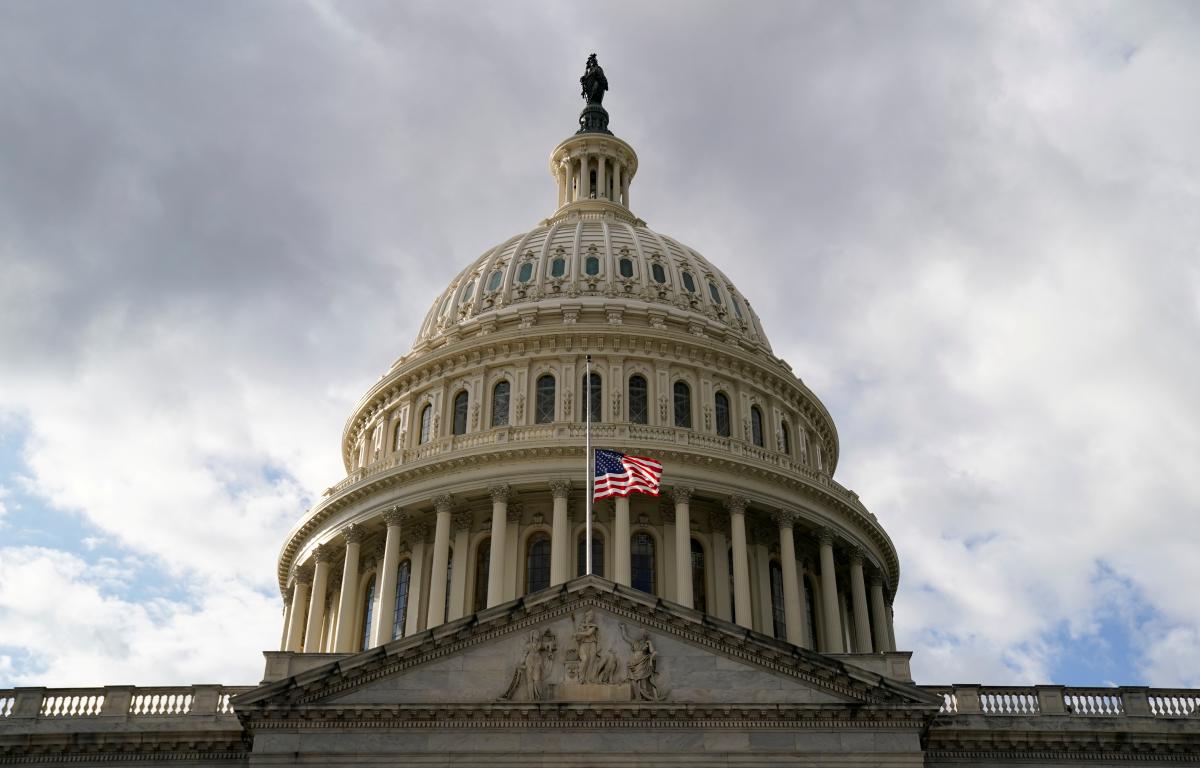
President Donald Trump's role this week in the unexpected return of Nvidia chief executive Jensen Huang is one of several signs that his loss of a congressional majority may not weaken his drive for executive power, but strengthen it, according to the Atlantic Council, a Washington-based foreign policy think tank.
The think tank said that even before Democrats take control of Congress in January, Trump had shown he was willing to intervene in the affairs of one of the world's most influential companies and in the United States' most important trade relationship, despite Democratic lawmakers preparing an attempt to repeal tariffs he has already imposed.
Nvidia is the world's largest maker of the semiconductor chips that power artificial intelligence systems, and Huang has become one of the most closely watched executives in global technology because of the company's central role in the US-China tech rivalry.
The Atlantic Council said the next two years may bring not a weaker presidency, but one that is far more contested, marked by clashes over power in Washington.
Divided government
The report recalled that President Harry Truman suffered a heavy defeat in the 1946 midterm elections, when his Democratic Party lost control of both the House of Representatives and the Senate for the first time in more than a decade.
Despite that defeat, Truman went on to achieve historic foreign policy successes, including the Marshall Plan to rebuild postwar Europe, the Berlin Airlift and the creation of NATO, the Atlantic Council noted.
It said Truman managed this by forging key alliances with internationalist Republicans, above all Senator Arthur Vandenberg of Michigan, who chaired the Senate Foreign Relations Committee.
The report said it does not expect a similar partnership between Trump and Democratic Senator Chris Coons of Delaware, who is expected to chair the Senate Foreign Relations Committee once Democrats take control.
It predicted that relations between the two would likely be poisoned by deep disagreements over Ukraine and Iran, as well as by expanding Democratic investigations into alleged conflicts of interest within the Trump administration.
Risk of escalation in Ukraine
The Atlantic Council warned that the danger is that Russian President Vladimir Putin could misjudge the situation as a chance to escalate the war in Ukraine without facing consequences.
It said Putin understands that any future US president is likely to be less critical of Ukrainian President Volodymyr Zelensky than Trump, who recently referred to the Russian leader as a friend.
Conversely, the report said, a more pro-Ukraine Congress could increase pressure on Trump to keep supporting Ukraine, complicating any Russian calculation that US backing will fade.
At the same time, the Atlantic Council said Putin's problem is that his forces in Ukraine have been stuck in a stalemate for months, which is why he has intensified strikes on civilian infrastructure, since that is the only move still open to him there.
The report said Putin's likely next step is to escalate hybrid attacks on Ukraine's European supporters, while simultaneously stepping up his charm toward Trump in an effort to push him to put more pressure on Zelensky to accept questionable Kremlin peace terms.
Technological instability
The Atlantic Council said the events surrounding Nvidia highlighted how closely the fortunes of companies, national security, technological leadership and financial markets have become intertwined, so that shocks in one area can have consequences for the others.
It said the next two years could prove among the most dangerous in recent memory, not because of any single factor, but because so many significant developments are unfolding at once and interacting with increasing speed.
As they prepare for confrontations in 2027, the report said, Trump and the Democrat-led Congress must recognise that getting through this period without serious trouble will require them to work together.
Trump and Putin's meeting in Shenzhen
Trump has said that during a meeting with Putin in Shenzhen, China, he warned the Russian leader against aggression in Europe. He said he had spent a lot of time trying to get Putin to end the war against Ukraine, and that he genuinely believes there is a strong chance of reaching a deal between Ukraine and Russia. He said ending the war would be a great tribute to everyone.
Separately, twenty members of the US House of Representatives called on Trump to withdraw his invitation to Putin for the G20 summit, a gathering of the world's largest economies due to be held in Miami on December 14 and 15.
In their letter, the lawmakers urged that the invitation be revoked over Putin's war against Ukraine and reports of Russian military assistance to Iran, saying this is not the time for economic cooperation or talks with Russia, except for discussions on ending the war in Ukraine.
What happens next
Democrats are set to take control of Congress in January, and the G20 summit Putin has been invited to is scheduled for December 14-15 in Miami.
Test yourself
- According to the Atlantic Council, what historical period does the report compare to Trump's current situation?
- Who does the Atlantic Council expect to chair the Senate Foreign Relations Committee?
- Why has Vladimir Putin intensified attacks on Ukraine's civilian infrastructure, according to the report?
Have your say
Should the US president have broad authority to set trade and tech policy, or should Congress have more say?
Where it happened
Washington, D.C., United States