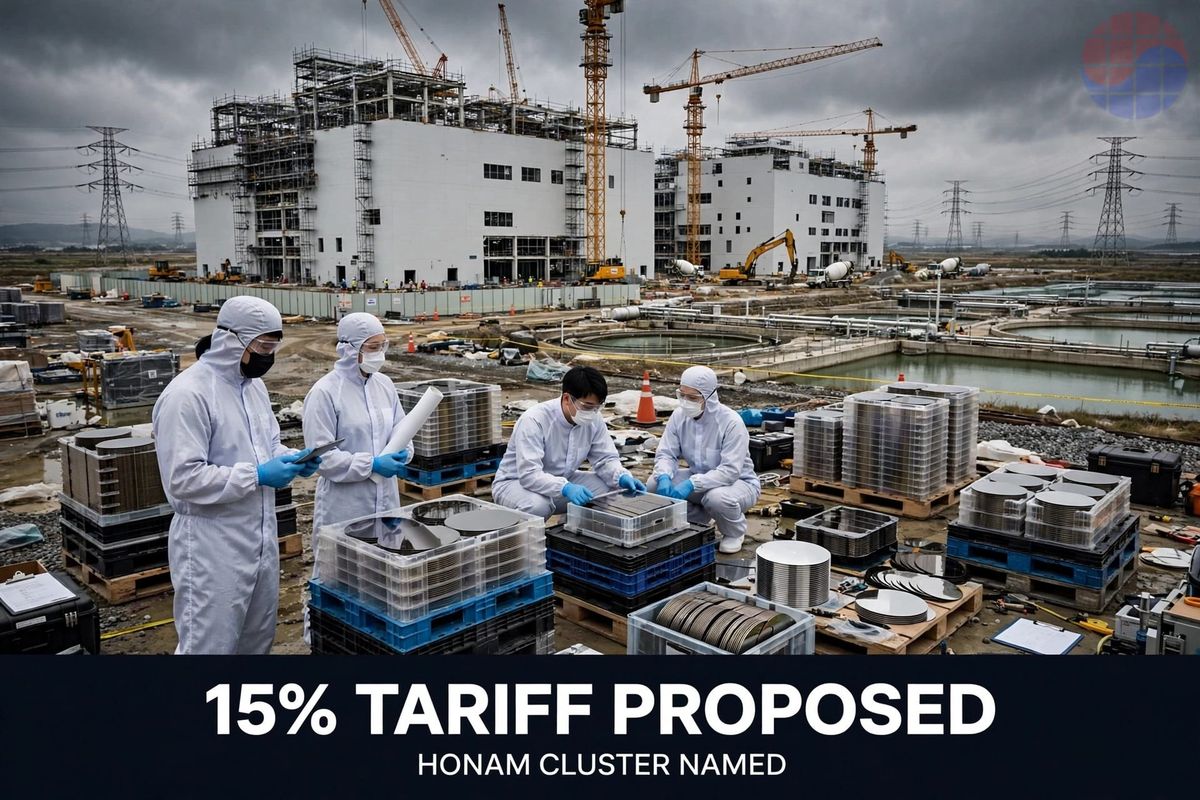
USTR Names Korea's Honam Chip Cluster in Its Section 301 Overcapacity Case — 5 Facts (Section 301 · 15% Tariff)
On November 25, 2026, USTR's Section 301 overcapacity findings proposed a tariff ceiling of up to 15% for Korea and named the Honam chip cluster (30 trillion won over 15 years). Semiconductors were excluded from this round; a final decision is expected in March 2027. Five facts.
Conclusion first: on November 25, 2026 (US time), the Office of the United States Trade Representative (USTR) released the findings of its Section 301 investigation into "structural overcapacity" across 16 economies, and Korea was one of 14 economies facing findings and proposed action. For Korea, USTR proposed a tariff ceiling of up to 15%. The headline rate is not the story — for items already carrying a combined 12.5%, the added burden is at most 2.5 percentage points.
The story is the target. USTR did not only question Korean exports; it questioned the design of Korean industrial policy itself — subsidies, tax credits, policy finance and infrastructure — and it named one project by name: the Gwangju–Jeolla (Honam) semiconductor cluster, where it cited 30 trillion won (about $22.32 billion) of government support over 15 years plus power and water infrastructure expansion. Everything in this article describes a proposal, not a final tariff.
A final decision is expected in March 2027, according to NewsPim's analysis of the 194-page investigation report and the 131-page tariff notice.
Follow-up: this article continues our November 18, 2026 report on the Honam cluster land split — Honam Chip Cluster Land Split Takes Shape: Samsung South, SK hynix North. That piece covered where the fabs would sit. This piece covers what Washington now says about the policy behind them.
The proposal at a glance
| Item | What USTR proposed or found (Nov 25, 2026) |
|---|---|
| Investigation | Section 301 probe into structural overcapacity, opened in March 2026, covering 16 economies |
| Findings | Findings and proposed action for 14 economies; Mexico and Norway excluded |
| Korea ceiling | Up to 15%, set with the existing Korea–US deal in view ($350 billion Korean investment pledge; reciprocal tariff cut from 25% to 15%) |
| Added burden | Items already at a combined 12.5% face at most +2.5 percentage points |
| Conditional card | Up to 25% (MFN / prior Section 301 exclusions) if consultations or deal implementation are judged insufficient |
| Excluded this round | Semiconductors and automobiles; Section 232 automobiles and parts also proposed for exclusion |
| Still exposed | Home appliances, petrochemicals, ships and other lines may face added burdens |
| Named sectors | Semiconductors, automobiles, petrochemicals cited for overcapacity |
| Named project | Gwangju–Jeolla (Honam) semiconductor cluster: 30 trillion won over 15 years plus power and water infrastructure |
| Timeline | Final decision expected March 2027 (NewsPim analysis) |
Fact 1: The Korea number is 15%, and the arithmetic caps the direct hit at +2.5 percentage points
USTR proposed a ceiling of up to 15% on Korean goods. That number was not chosen in isolation. It sits next to the existing Korea–US agreement under which Korea pledged $350 billion of investment in the United States and the reciprocal tariff was lowered from 25% to 15%. For product lines whose combined burden is already 12.5%, the proposal therefore adds at most 2.5 percentage points (VLSI Korea calculation: 15.0 minus 12.5).
That is a real cost for low-margin exporters, but it is not, by itself, a shock of the size the headline suggests. Readers should hold two ideas at once: the proposed rate is bounded, and the reasoning behind it is not. The rate can be negotiated inside a range USTR has already published.
The reasoning — that Korean industrial policy structurally creates overcapacity — reaches much further, because it can be reused in the next investigation, the next sector review and the next negotiation.
Fact 2: Semiconductors and automobiles are excluded from this additional tariff — and that exclusion is itself information
Semiconductors and automobiles were excluded from the additional tariffs in this round, and USTR also proposed excluding automobiles and parts covered by Section 232. For the chip industry, the immediate cash impact of this specific proposal is therefore limited. Home appliances, petrochemicals and ships do not share that shelter and may still face added burdens. The exclusion should be read carefully. It does not say Washington accepts Korea's semiconductor model.
The same findings name semiconductors first among the sectors cited for overcapacity. What the exclusion says is narrower: in this instrument, at this step, chips are not the collection point. Other instruments — Section 232, export controls, investment screening and negotiation over the $350 billion pledge — remain available. A company that reads "excluded" as "settled" is reading one page of a 194-page report.
Fact 3: The structural case rests on three ratios — 28.3%, 35.9% and a surplus that rose 94%
USTR's structural argument compares the shape of the two economies. Manufacturing was 28.3% of Korea's GDP on average over 2021–2025, against 9.9% in the United States. Goods exports were 35.9% on the Korean side of the comparison, against 7.1% for the United States. Korea's goods surplus with the United States rose from $28.5 billion to $55.2 billion, an increase of about 94% (VLSI Korea calculation: 55.2 divided by 28.5, minus one, is 93.7%).
None of these numbers is new to economists. What is new is their legal use: they are assembled as evidence that the surplus is not a market outcome but a policy outcome. That framing matters because a market outcome is answered with competitiveness, while a policy outcome is answered with policy changes — subsidy design, tax credit conditions, policy finance terms and infrastructure support.
The negotiation, if it comes, will be about the design of support, not only about tariff lines.
Fact 4: The Honam cluster was named — 30 trillion won, power and water, and the 2021 K-Semiconductor Strategy
The most concrete passage for the chip industry concerns the Honam cluster. USTR cited the Gwangju–Jeolla semiconductor cluster plan as a case in which 30 trillion won (about $22.32 billion) of government support over 15 years, together with expanded power and water infrastructure, increases production capacity regardless of market demand.
It also cited the 2021 K-Semiconductor Strategy — tax credits, infrastructure, regulatory reform and workforce programmes — as an intervention case. Behind the project-level criticism sits a market-share claim: Samsung Electronics and SK hynix together hold more than 70% of the world DRAM market and 51% of NAND, and USTR argued that government support helped maintain that dominant position. For readers of our November 18 report, the implication is direct.
The Honam site contest was a domestic story about land, water and timing. It is now also an exhibit in a US trade file. That does not stop the project, and nothing in the proposal sets a condition on it by name. But every future support package attached to the cluster — its size, its form, its conditions — now has a second audience in Washington as well as in Seoul.
Fact 5: The 25% conditional card, the China channel argument, and the March 2027 clock
The proposal contains a second, larger number. If consultations or implementation of the existing agreement are judged insufficient, USTR proposed going up to 25%, at MFN or prior Section 301 exclusion levels. That conditional structure is the leverage: the 15% ceiling rewards the existing deal, and the 25% card prices its failure.
USTR Representative Jamieson Greer said on CNBC that Korea "introduced several government support and infrastructure plans this summer" — a remark that connects the summer's cluster announcements directly to the investigation. The findings also reach beyond Korea's own policy.
USTR pointed to Korean use of Chinese intermediate goods, the Korea–China FTA and what it described as insufficient protection for foreign workers, raising the concern that Korea could serve as a channel around measures aimed at Chinese overcapacity. A final decision is expected in March 2027, per NewsPim's analysis.
Between now and then, the operative questions are procedural: what Korea offers in consultations, how the $350 billion investment pledge is documented, and whether any support programme is redesigned before Washington redesigns the tariff.
What this means strategically
First, the unit of trade pressure has moved. Twentieth-century trade disputes taxed products at the border. This investigation evaluates the machinery behind the products — tax credits, infrastructure, policy finance and workforce programmes — and treats that machinery as the actionable act.
Korean ministries and companies therefore need a policy-design defence, not only a price defence: for each support measure, what market failure it answers, what conditions attach, and when it expires.
Second, the chip exclusion is a reprieve inside one instrument, not a verdict on the model. The findings name semiconductors as an overcapacity sector while excluding them from this tariff round. That combination — criticism on the record, collection deferred — is a familiar negotiating shape. It preserves the argument for later use.
📩 Following this story?
Get the follow-up analysis — earnings, reports and HBM supply — in your inbox daily at 10:30 KST. Subscribe free →
Third, regional projects now carry trade exposure. The Honam cluster's economics were already sensitive to power, water and timing. They are now also sensitive to how support is structured and described. Announcing support as a headline total over 15 years is exactly the format USTR quoted.
Future announcements may separate infrastructure (a public good) from firm-specific support, and may publish demand-linked conditions, because those distinctions are now part of the trade record.
Judgment and counter-arguments
Is a 70% DRAM share the result of support, or of competition? USTR's framing treats the share as policy-maintained. The counter-argument is on the record of the last three decades: Korean memory makers won share through yield learning, capital intensity sustained through downturns, and technology transitions — including periods when support was modest relative to the capex involved. Support can lower the cost of capacity; it does not manufacture yield.
Both statements can be true, and the consultation will likely turn on proportions, not on absolutes.
Does an overcapacity frame fit products that are in shortage? HBM is the obvious tension. The same industry accused of structural overcapacity sells its most advanced memory under allocation, with buyers competing for supply. An overcapacity claim that does not distinguish commodity capacity from constrained advanced capacity is analytically weak — but trade findings are not academic papers, and the distinction will only enter the record if Korea puts it there with data.
What should be watched before March 2027? Four things: the consultation agenda and any Korean offer on support design; documentation of the $350 billion investment pledge; any redesign or re-announcement of Honam cluster support; and whether appliances, petrochemicals or ships move from "exposed" to named lines in the final notice. If none of these move, the conditional 25% card becomes the story.
FAQ
Q1. Has a new 15% tariff on Korean goods taken effect?
No. USTR published findings and a proposal on November 25, 2026. For Korea the proposal is a ceiling of up to 15%; a final decision is expected in March 2027, according to NewsPim's analysis. Nothing in this round is a final, effective tariff.
Q2. Will Korean semiconductors face this additional tariff?
Semiconductors were excluded from the additional tariffs in this proposal, and automobiles were excluded as well, including a proposed exclusion for Section 232 automobiles and parts. Semiconductors were nevertheless named as an overcapacity sector in the findings, so the exclusion is specific to this instrument and this round.
Q3. How much more would Korean exporters actually pay?
For items already carrying a combined 12.5%, the proposed 15% ceiling adds at most 2.5 percentage points. The larger exposure is conditional: up to 25% if consultations or implementation of the existing Korea–US deal are judged insufficient.
Q4. Why was the Honam cluster named?
USTR cited the Gwangju–Jeolla cluster plan as a case in which 30 trillion won (about $22.32 billion) of government support over 15 years, plus power and water infrastructure expansion, raises production capacity regardless of market demand. It also cited the 2021 K-Semiconductor Strategy as an intervention case.
Sources
- USTR Section 301 investigations (ustr.gov) — investigation framework; findings announced November 25, 2026 (US time).
- BusinessKorea — reporting of the USTR findings, November 26, 2026.
- The Chosun Ilbo English edition — reporting of the findings, November 25, 2026.
- NewsPim — in-depth analysis of the 194-page investigation report and 131-page tariff notice, November 26, 2026, including the March 2027 final-decision expectation.
Disclosure: This article summarises a proposed measure published by USTR on November 25, 2026; it is not a final tariff decision. Figures are as cited in the findings and reporting named above, with VLSI Korea calculations marked as such. This article is industry information, not investment advice.
📩 Missed today's analysis? Get tomorrow's in your inbox
Daily Silicon at 10:30 KST plus earnings and analyst-report breakdowns, first. Samsung Electronics, SK hynix, TSMC and HBM supply, read by practicing engineers.
Subscribe free →
Free · No spam · Unsubscribe anytime
⚖️ Notice
This article is an industry and company analysis prepared from public sources — regulatory filings, company announcements and press reports — for information purposes only. It is not a recommendation to buy or sell any financial instrument and is not investment advice. Any target prices or investment opinions cited here are those of the institutions that issued them, not of VLSI Korea.
Forecasts and assessments are based on public information available at the time of writing, may differ from actual outcomes, and are not guaranteed to be accurate or complete. All investing involves a risk of loss of principal, and final investment decisions and their consequences rest solely with the investor.
This article was drafted with the assistance of AI tools and is reviewed and published by an editor. If you find a factual error, please let us know via our corrections page; verified errors are corrected with a visible correction note.
Editor's note (conflict-of-interest disclosure): The operator of VLSI Korea is a practicing engineer in the EDA industry. This article was prepared solely from public sources (regulatory filings, press releases, papers, and public data), and no non-public information of the operator's employer was used. This article is not a view of the employer; it is the analysis of a personally operated publication unrelated to the employer.