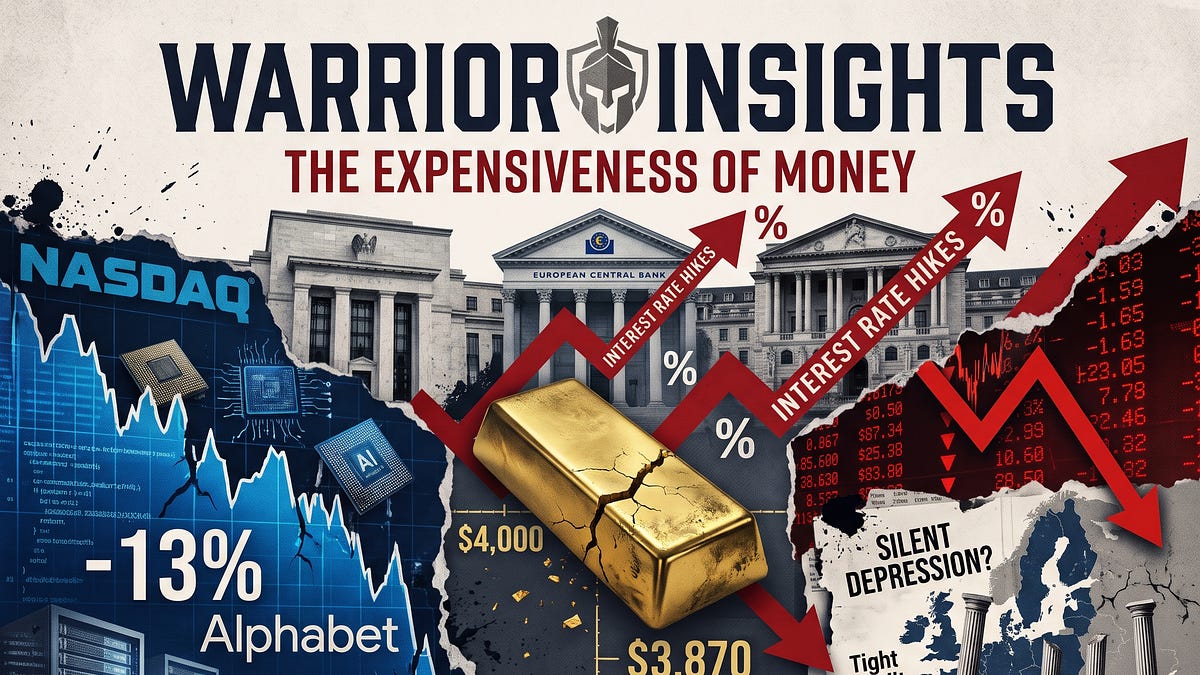
Last week, tech, gold, and stocks all fell at the same time. Alphabet lost nearly $500 billion in a single day, its worst day since its 2004 IPO. The Nasdaq 100 slid into a correction. Gold broke below $4,000 to its lowest level in more than a year. And behind all of it, central banks on three continents were either raising interest rates or signaling that more hikes are coming.
These aren’t separate stories. They share a root: money is getting more expensive while growth is getting harder to find. Europe, where the European Central Bank has already hiked twice and banks are pulling back on lending, is showing what that can look like in practice.
In this article, I’ll walk through each piece, connect them, and give you a plan for what to do, because this week’s calendar, with midterm elections Tuesday and a jobs report Friday, could move all of it again.
The AI Trade Hit a Wall
On Thursday, Alphabet fell about 13% after its results raised questions about whether massive AI spending is paying off. The sell-off wiped out nearly $500 billion in market value. Friday brought a broader rout: the S&P 500 fell 1.82% to 7,580.07, the Nasdaq Composite fell 2.86% to 25,437.00, and the Nasdaq 100 fell 3.46%, entering its third correction of the year.
Intel dropped about 28.6% after warning of a weak fourth quarter, with its CFO saying the PC slowdown could last through the first half of next year. Amazon fell about 2% after an earnings miss, with trailing 12-month free cash flow a net outflow of more than $42 billion. The iShares semiconductor ETF lost 8.24% on the day.
For October as a whole, the Nasdaq fell roughly 5%, its worst month since March 2025. Some perspective: the S&P 500 is still up about 10.7% for the year. But the message from investors is clear: they’re no longer willing to pay any price for AI promises, especially when borrowing costs are higher. Hyperscaler capital spending is expected to total around $800 billion this year, and that kind of spending looks different when money costs more.
Gold Fell Below $4,000: The Safe Haven That Wasn’t
You might expect gold to rise in a week like this, with a war in the Middle East and stocks falling. Instead, spot gold dropped to about $3,870 on Friday, its lowest in more than a year and down about 3.7% on the week. Analysts point to the Fed’s hawkish tilt, a stronger-than-expected GDP report, a firmer dollar, and forced selling as investors dumped assets across the board to cover losses in tech.
The split in sentiment is striking. In Kitco’s weekly survey, 10 of 16 professional analysts (63%) were bearish on gold for the coming week, while 53% of respondents to its online poll expect gains. Retail investors are buying the dip, and Wall Street is not. If you took my advice from the early October article not to chase gold on headlines alone, this is why: a metal that’s supposed to protect you can fall just as fast as it rises.
The point of investing in physical precious metals is to act as a store of value and protect your purchasing power in the future. To hold onto it and only sell it if you need to.
Central Banks Are Hiking Again
The Federal Reserve held rates at 3.75% to 4.00% on Wednesday in a 10-2 vote, with Governor Lisa Cook and Cleveland Fed President Beth Hammack dissenting in favor of a hike. Since then, Fed officials have kept the pressure on. Reports say Dallas Fed President Lorie Logan sees two more hikes but says the pace can be gradual, and St. Louis Fed’s Alberto Musalem also signaled more tightening.
Futures price a December hike at roughly 72% to 85%, depending on the source and the day.
The European Central Bank held its deposit rate at 2.5% on Thursday after raising it twice in the past five months, and President Christine Lagarde said policymakers discussed a hike before choosing to wait. She also announced she’ll step down in February. Euro zone inflation could climb above 4%, and markets still price another ECB hike in December.
This week, the Reserve Bank of Australia is expected to raise rates Tuesday and the Bank of England on Thursday, with markets pricing a Bank of England hike to 4.00% at about 98%.
Energy is the common thread. West Texas Intermediate crude rose 15.2% in October and Brent 13.6%, a fourth straight monthly gain, and the expiring December Brent contract settled at $117.64, its highest since late April. UKMTO logged 144 maritime “incidents” in the Middle East region in October, the most since the (constitutionally undeclared) war began February 28th.
When energy drives inflation, central banks hike even as growth slows, which is the toughest position for them to be in.
Europe Is the Warning
Europe is where you can see the cost of this kind of tightening most clearly. Some commentators describe the region’s long stagnation, which dates back to the 2008 financial crisis and the 2011 eurozone debt crisis, as a “silent depression.” Whatever you call it, Europe relies far more on bank lending than the U.S., which has deeper capital markets, so when banks pull back, the real economy feels it quickly.
Start with the banks. HSBC reported third-quarter pre-tax profit of $9.6 billion, up 32% from a year earlier, which sounds great. But revenue of $18.6 billion missed estimates, its wealth business slowed, and the shares fell roughly 6%. It’s also worth noting that part of the year-over-year jump reflects the absence of $1.4 billion in legal provisions booked a year earlier. The lesson is that higher rates don’t automatically translate into healthy bank profits.
The ECB’s own survey explains why. Its October bank lending survey shows banks tightening credit: a net 9% of banks tightened standards for businesses and 14% for consumer credit, citing higher risk perceptions and lower risk tolerance. Demand is falling too. Demand for housing loans dropped by a net 27% in the third quarter, with higher interest rates the main reason, and banks expect it to fall by about 36% in the fourth quarter.
Banks also reported that retail funding conditions worsened by the most since the survey began in 2011. Credit is getting both more expensive and harder to get.
France shows what that looks like politically. Insee reported Friday that French GDP fell 0.1% in the third quarter, after a flat second quarter and a 0.2% drop in the first, which means no growth so far this year. Inflation rose to 3.4% in October, the highest since January 2024.
A budget deadlock has fueled a bond sell-off that pushed France’s 10-year borrowing costs above 5% last week, and the economy minister warned that without a budget the country “will hit the wall.” Headlines have described the worst unrest in years, driven by student protests over budget cuts. To be fair, French household consumption did rise 0.4% last quarter, so this isn’t a collapse.
But it’s an economy at a standstill, with the central bank and the government both short on options.
How the U.S. Compares
The U.S. isn’t Europe. Third-quarter GDP grew at a 3.4% annual rate, and the Fed describes the economy as expanding at a “strong pace.” But rate-sensitive parts of the economy are showing the same early signs. Pending home sales fell 11.3% from a year ago, mortgage applications are well below last year, and real disposable income fell 0.3% in September as inflation outran paychecks.
Europe’s housing-loan numbers are a preview of what happens when rates stay high for long enough.
What This Week Could Change
Monday brings the ISM manufacturing report. Tuesday is Election Day in the U.S., plus the RBA’s decision. I won’t weigh in on politics here, but markets treat elections as event risk, and some analysts cite them as a source of risk-off sentiment. Wednesday brings ADP employment and eurozone inflation data. Thursday, the Bank of England decides. Friday is the October jobs report, with forecasts around 50,000 to 55,000 new jobs and unemployment holding at 4.2%.
A weak report could reduce December hike odds, while a strong one could keep pressure on stocks and gold. Apple, Palantir, AMD, and Qualcomm also report this week, which will tell us whether last week’s AI fears were a blip.
What This Means for the Real Estate Market
The mortgage rate has dipped, with Freddie Mac’s 30-year average at 7.24%, but it’s nowhere near last year’s 6.17%, and another Fed hike in December would keep long-term rates elevated. Wealth effects matter too: if you or your buyers hold a lot of tech stock or gold, last week’s losses may change what they feel comfortable spending. For buyers, this is still a market with thinner competition and more room to negotiate seller credits, buydowns, and closing flexibility.
For sellers, pricing realistically and being willing to offer concessions will matter more than ever. The tools I outlined last week, from rate locks with float-down options to assumable loans, apply even more strongly if another hike is coming.
How to Get Ahead of What’s Coming
Check how concentrated your investments are. Many retirement accounts and index funds hold heavy positions in a handful of mega-cap tech companies, so last week’s sell-off may have hit you harder than you realize. Look at what you actually own, and make sure your mix matches your timeline and your comfort with risk, rather than reacting after another bad week.
Don’t chase, and don’t panic. Gold’s drop and tech’s drop are reminders that both can move fast in either direction. If you want to add to any position, consider spreading purchases over time instead of making one large move, and decide in advance what you’d do if prices fall further.
Make higher rates work for you where you can. With the 2-year Treasury near 4.56% and the 10-year near 4.9%, cash and short-term Treasuries pay something meaningful now. At the same time, pay down variable-rate debt, because if the Fed and other central banks keep hiking, those balances only get more expensive.
Budget a buffer for energy and winter costs. With oil up 15% in a month and Hormuz still unstable, heating, fuel, and freight costs can surprise to the upside. Build that cushion into your budget now rather than absorbing it later.
Protect your income and your cash cushion. Europe’s experience shows that when credit tightens, demand and jobs follow. A three-to-six-month emergency fund, sharper skills, and a second source of income give you room to maneuver if the slowdown spreads.
Your turn: after last week, are you adding to tech, holding gold, or sitting in cash? Hit reply or drop a comment below. I want to hear from you.
Until next time my fellow Warriors, Stay Informed, Stay Vigilant, Ever Forward.